
Thought leadership
The Complete Guide to Digital Antimicrobial Stewardship
A practical guide for clinical pharmacy and antimicrobial stewardship teams on governing local guidelines, improving point-of-care access, and building a modern digital stewardship program.
By Eolas MedicalPublished
Antimicrobial stewardship depends on more than developing the right guideline.
The guidance also has to be current. It has to reflect local resistance patterns, formulary decisions, and organizational practice. Clinicians need to be able to find it when they are making a prescribing decision. And stewardship teams need a way to know whether that guidance is actually reaching the point of care.
For many hospitals, that creates a challenge that is partly clinical and increasingly operational: How do you turn a growing library of antimicrobial guidelines, antibiograms, pathways, policies, and educational resources into clinical knowledge that can be governed, updated, found, and used consistently?
That is where digital antimicrobial stewardship platforms come in.
Rather than simply putting antimicrobial guidelines online, digital stewardship connects the work happening behind the scenes, including pharmacy review, infectious diseases expertise, microbiology data, content approval, version control, communication, and measurement, with the moment a clinician needs guidance.
The CDC's Core Elements of Hospital Antibiotic Stewardship Programs emphasize leadership commitment, accountability, pharmacy expertise, action, tracking, reporting, and education. CDC implementation guidance also emphasizes facility-specific treatment recommendations and monitoring how antibiotic stewardship interventions are working.
Digital stewardship can provide the knowledge infrastructure that helps those activities work at scale.
At a glance
Digital antimicrobial stewardship connects the creation and governance of local antimicrobial guidance with the moment clinicians need it.
A mature digital stewardship program should help teams:
- Maintain one trusted source for local guidance
- Control ownership, review and versioning
- Make knowledge easier to find at the point of care
- Support multidisciplinary stewardship collaboration
- Ground AI answers in approved clinical content
- Measure whether guidance is actually being reached
What is digital antimicrobial stewardship?
Digital antimicrobial stewardship is the use of digital systems to help healthcare organizations create, govern, distribute, discover, apply, and measure antimicrobial stewardship knowledge.
It is not simply converting a binder into a PDF library.
A mature digital stewardship model connects the entire lifecycle of clinical guidance:
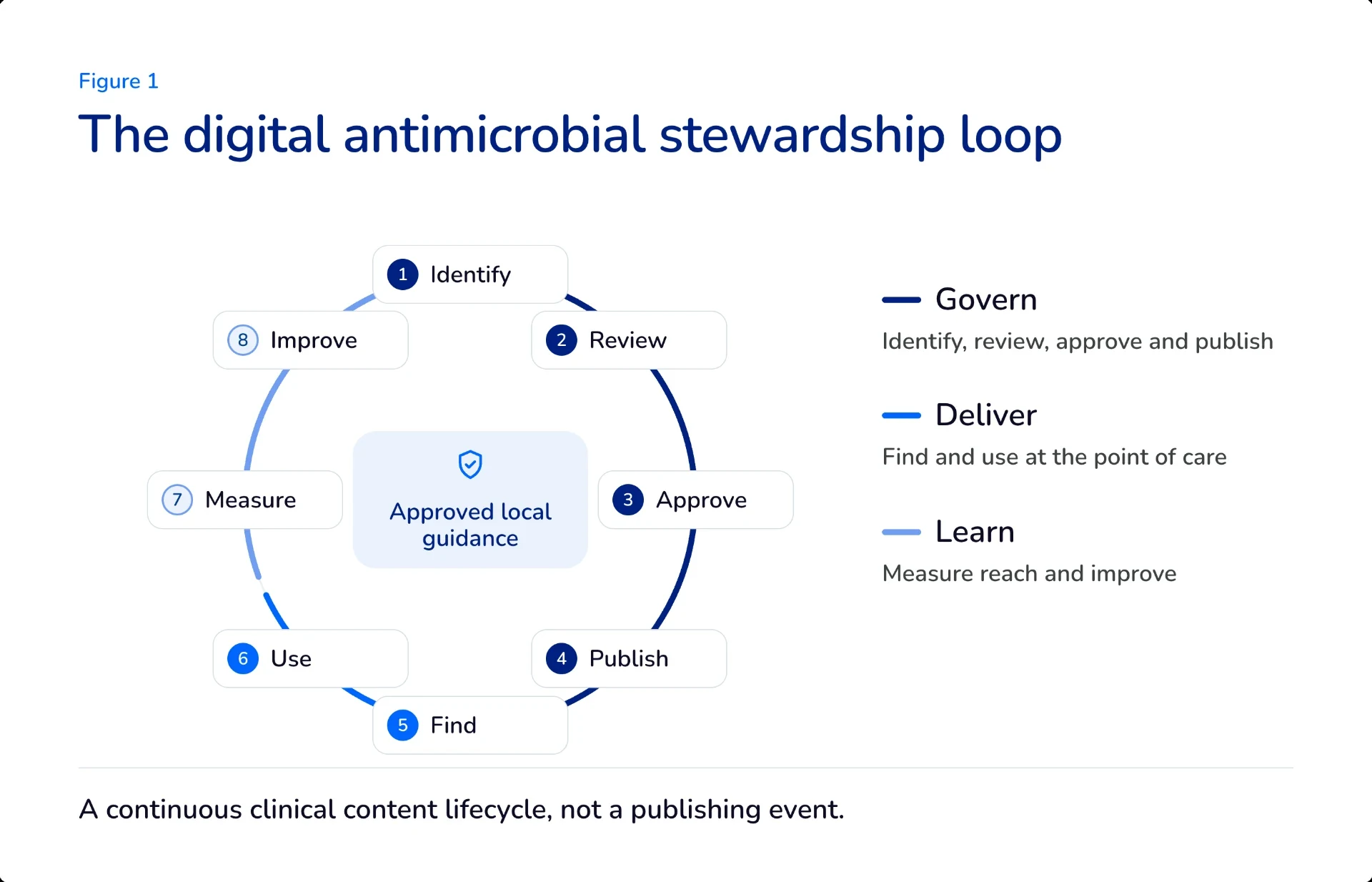
Identify → Review → Approve → Publish → Find → Use → Measure → Improve
That can include everything from local prescribing guidelines and antibiograms to dosing resources, restricted antimicrobial policies, de-escalation guidance, surgical prophylaxis recommendations, and specialty-specific pathways.
The objective is to create a trusted system in which the stewardship team maintains control of the clinical content while frontline clinicians can access the latest approved guidance quickly.
This operational component is increasingly important because antimicrobial stewardship itself is multidisciplinary.
In 2026, SHEA, SIDP, PIDS, and IDSA published updated guidance describing the knowledge and skills required of antimicrobial stewardship leaders. Beyond infectious diseases, pharmacotherapy, and microbiology expertise, the guidance highlights areas including communication, collaboration, quality improvement, change management, measurement, and information technology.
In other words, antimicrobial stewardship is not only about what the recommendation should be.
It is also about how the recommendation moves through an organization and reaches clinical practice.
Why antimicrobial guideline management has become a knowledge-management problem
Most hospital antimicrobial stewardship programs do not have a shortage of information.
They have the opposite problem.
A single program may be responsible for maintaining:
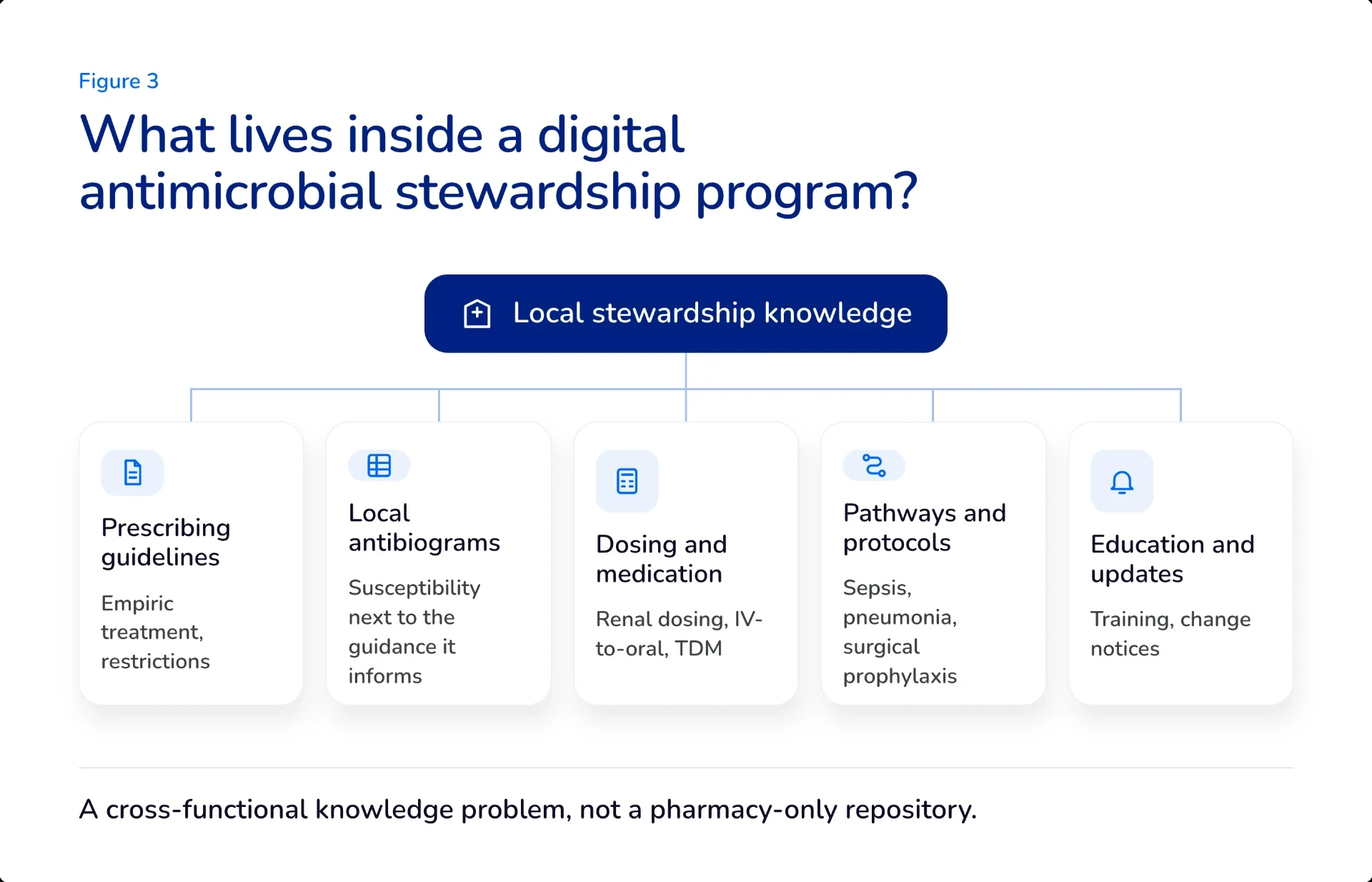
- Empiric treatment guidelines
- Local antibiograms
- Renal dosing guidance
- IV-to-oral conversion criteria
- Antimicrobial restriction policies
- Allergy guidance
- Surgical prophylaxis recommendations
- Sepsis pathways
- Therapeutic drug monitoring resources
- Formulary guidance
- Microbiology resources
- Education and training materials
And each resource has a lifecycle.
Evidence changes.
Resistance patterns change.
The formulary changes.
A medication shortage changes what is practical.
A hospital committee approves a new recommendation.
A guideline is updated.
But publishing the new document is only one step.
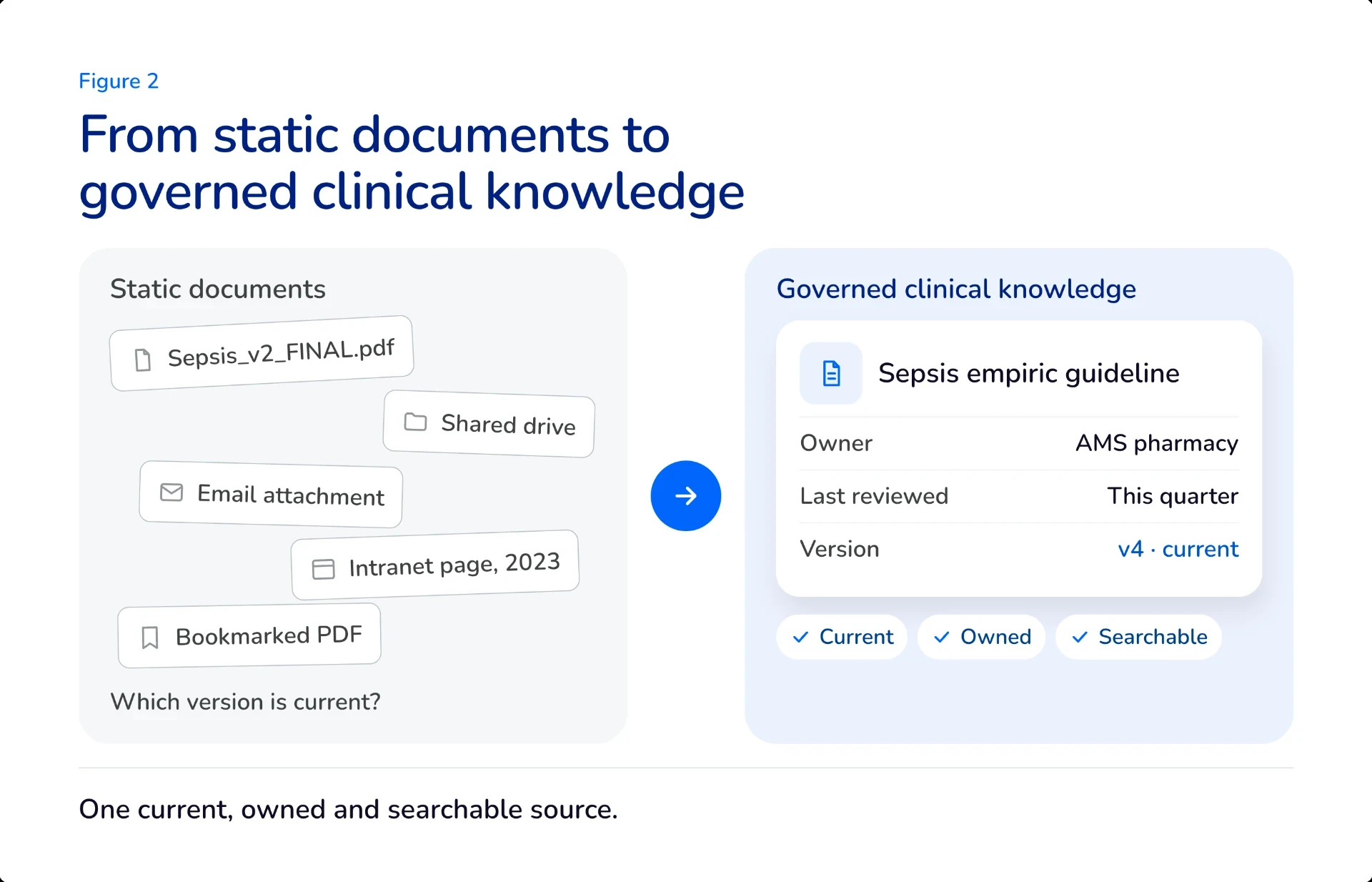
An older version may still exist on an intranet page. Another may be saved to a shared drive. Someone may have downloaded a PDF months earlier. A clinician may have bookmarked a document that has since been superseded.
The health system can technically have an up-to-date guideline while a clinician can still encounter an outdated one.
That is why antimicrobial guidelines management should be treated as a continuous clinical content lifecycle rather than a publishing event.
U.S. stewardship frameworks reinforce the need for coordinated infrastructure across pharmacy, medical staff, microbiology, infection prevention, quality improvement, information technology, and hospital leadership.
Digital knowledge governance does not replace those responsibilities.
It can make them easier to operationalize.
What antimicrobial stewardship content needs to be managed digitally?
The exact content will vary by organization, but digital antimicrobial stewardship often needs to bring together several different forms of local knowledge.
Facility-specific prescribing guidelines
National guidelines provide an essential evidence base, but local antimicrobial treatment recommendations may also account for institutional resistance patterns, formulary decisions, patient populations, available diagnostics, and local workflows.
Facility-specific treatment recommendations are an important part of the CDC hospital stewardship framework.
Local antibiograms
Antibiograms can be essential to empiric decision-making, but they are only useful if clinicians can locate the current version when they need it.
A digital stewardship environment can place susceptibility information alongside the prescribing resources it informs rather than treating the antibiogram as a separate document clinicians have to hunt down.
Dosing and medication guidance
Renal dose adjustments, therapeutic drug monitoring, IV-to-oral criteria, restricted antimicrobial policies, allergy guidance, and other medication-specific resources often sit across multiple systems.
Bringing these resources into the same searchable knowledge environment can reduce the number of places clinicians have to look.
Pathways and protocols
Sepsis pathways, pneumonia guidance, urinary tract infection pathways, surgical prophylaxis recommendations, skin and soft tissue infection guidance, and other local protocols may span departments well beyond pharmacy.
Digital stewardship therefore becomes a cross-functional knowledge problem rather than a pharmacy-only content repository.
Education and stewardship updates
Stewardship programs also need to communicate changes.
A newly approved recommendation does little good if the clinicians affected by it do not know it changed.
Digital platforms can help connect the content itself with education, updates, and targeted communication.
Seven capabilities to look for in a digital antimicrobial stewardship platform
Not every digital tool solves the same problem.
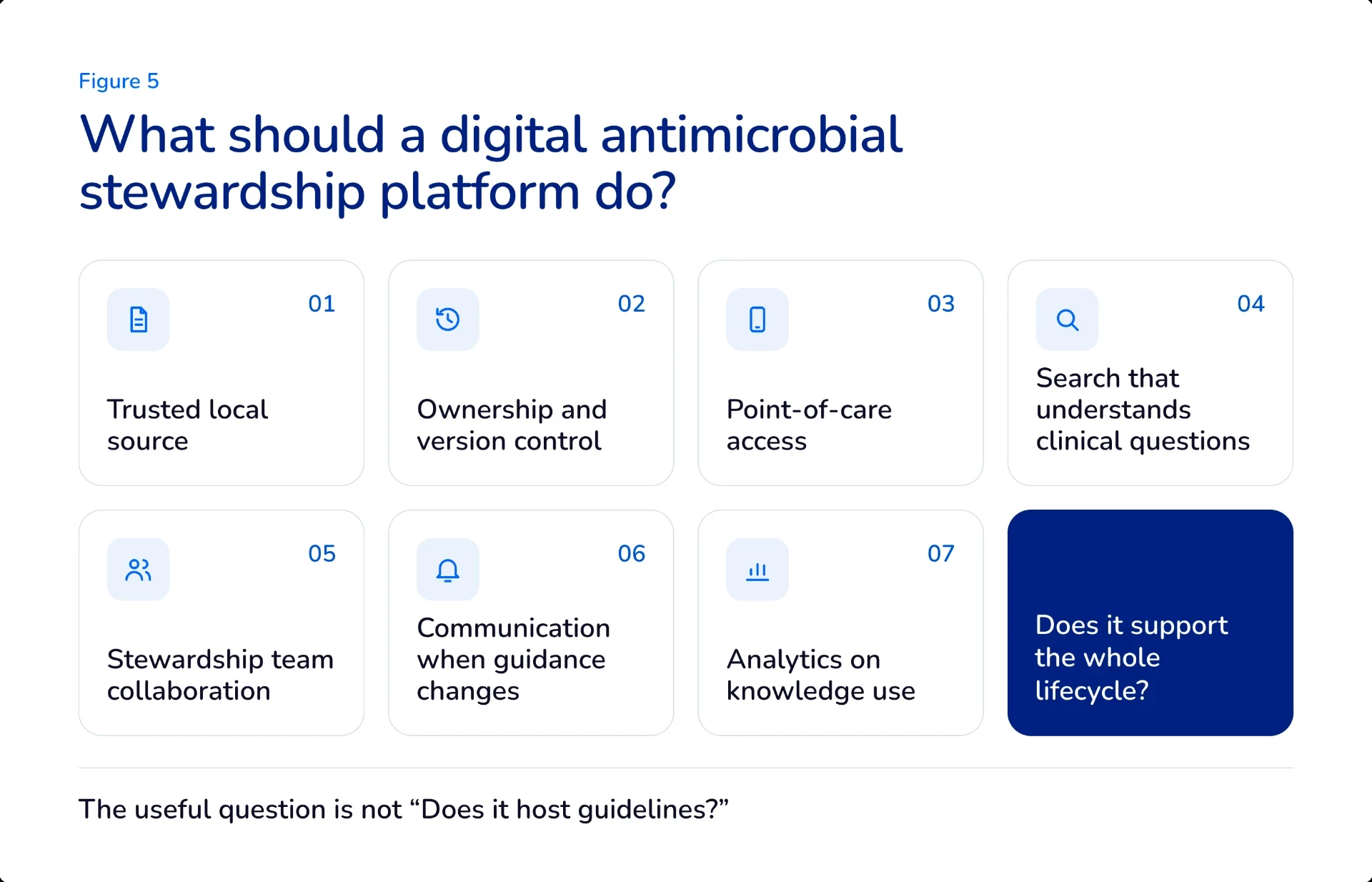
For clinical pharmacy and stewardship leaders evaluating digital antimicrobial stewardship platforms, the useful question is not simply, "Does it host guidelines?"
A stronger question is:
Can it support the entire lifecycle of local antimicrobial knowledge?
1. A trusted source for local antimicrobial guidance
The first requirement is straightforward: clinicians need to know where the authoritative version lives.
A platform should be able to bring together hospital-specific resources such as local antimicrobial guidelines, antibiograms, formulary guidance, dosing resources, restriction policies, treatment pathways, clinical calculators, education, and supporting evidence.
The goal is not simply centralization for its own sake.
It is confidence.
When a clinician finds a resource, there should be as little ambiguity as possible about whether it is the organization's current approved guidance.
2. Clear ownership, review, and version control
Every important clinical resource should have an identifiable lifecycle.
Who owns it?
When was it last reviewed?
Who can change it?
What is the current version?
What did the previous version say?
When should it be reviewed again?
This is where clinical content updating becomes a governance process rather than document maintenance.
Digital systems should make it possible to update the authoritative resource while reducing the risk that competing versions remain in circulation.
For multi-hospital systems, that governance model may also need to support both enterprise-wide standards and appropriate local variation.
3. Fast access at the point of care
A guideline can be clinically excellent and still fail operationally if clinicians cannot find it.
Searchability and accessibility therefore matter.
A resident working overnight should not necessarily need to know the exact document title, folder structure, intranet location, or committee that produced a guideline before finding the answer they need.
The same applies to pharmacists on rounds, attending physicians moving between units, and clinicians working across multiple sites.
Point-of-care knowledge should be designed around the way clinicians look for information, not around the organizational chart.
IDSA and SHEA stewardship guidance has recognized a role for computerized clinical decision support when appropriate information-technology resources are available.
The broader principle is simple: guidance creates more value when clinicians can reach it during the decision itself.
4. Search that understands clinical questions
Traditional keyword search works well when someone already knows what document they need.
Clinical questions rarely arrive as document titles.
A prescriber may instead ask:
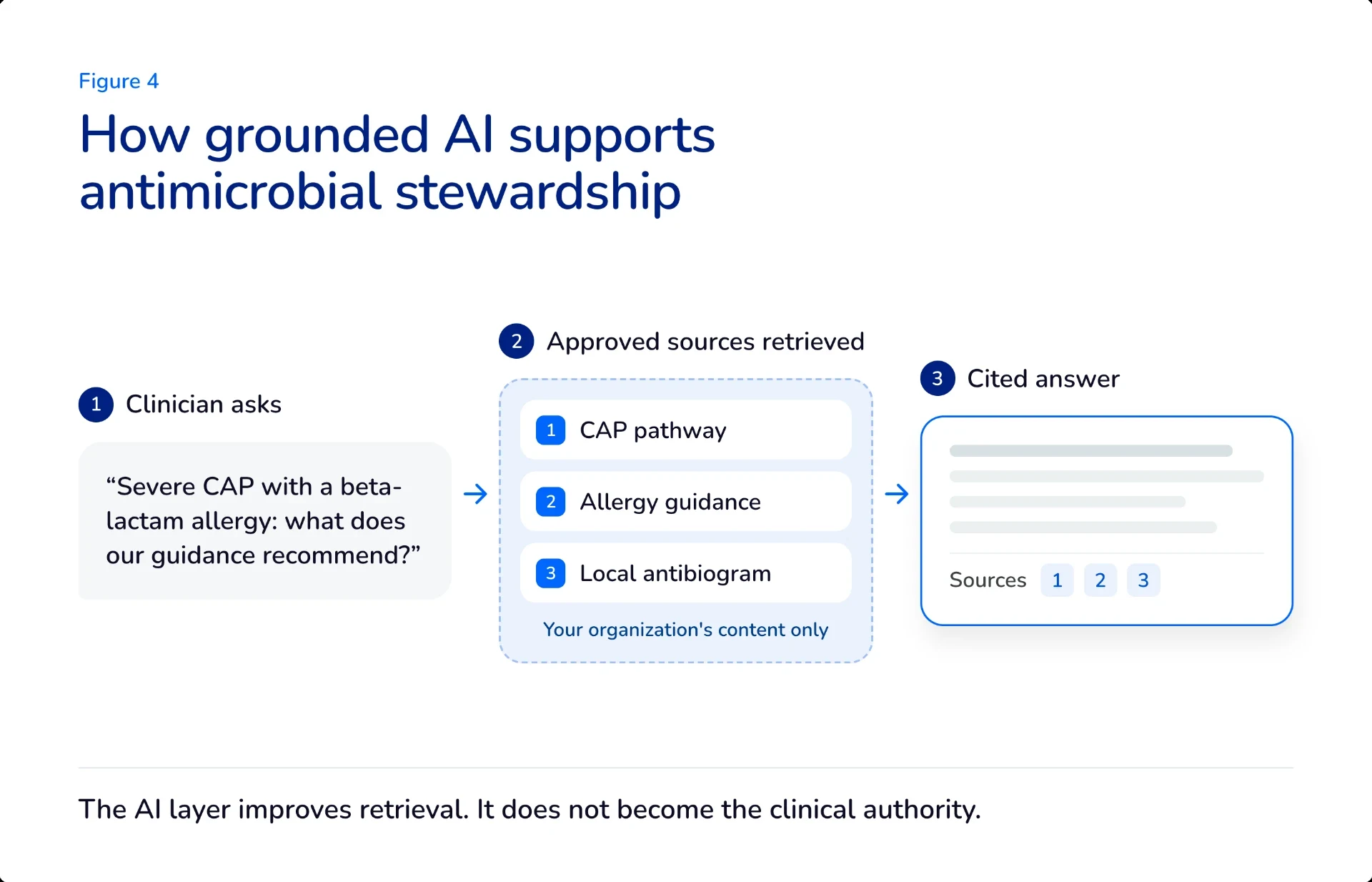
"What does our local guidance recommend for severe community-acquired pneumonia in a patient with a beta-lactam allergy?"
The relevant answer may sit across a treatment pathway, an allergy guideline, a dosing document, an antibiogram, or several pieces of content at once.
This is one area where retrieval-augmented AI can add value.
Instead of asking a general-purpose language model to answer from broad training data alone, retrieval-augmented generation, or RAG, can first search an organization's defined clinical knowledge and then generate a response grounded in the retrieved sources.
For antimicrobial stewardship, this distinction is important.
The objective is not:
"What does AI think I should prescribe?"
It is closer to:
"What does our approved guidance say, and where did that answer come from?"
The quality and governance of the underlying source content therefore remain critical.
AI cannot make outdated or contradictory institutional guidance trustworthy.
It can make well-governed knowledge easier to interrogate.
5. Collaboration across the stewardship team
Antimicrobial stewardship content rarely belongs to one person.
Depending on the organization and resource, contributors may include:
- Antimicrobial stewardship pharmacists
- Infectious diseases physicians
- Microbiology
- Infection prevention
- Quality and safety
- Nursing
- Specialty clinicians
- Clinical governance
- Information technology
Good pharmacy team collaboration should not require sacrificing content control.
A digital platform should support clear permissions and ownership while making it practical for multidisciplinary teams to contribute to the content lifecycle.
The stewardship team needs enough control to maintain trust in the resource without creating a workflow in which every minor update becomes an IT project.
6. Communication when guidance changes
Publishing does not equal awareness.
Some updates are relatively minor.
Others could immediately change clinical practice:
- A new first-line antimicrobial
- A revised dosing recommendation
- A change in local susceptibility patterns
- A medication shortage
- A new prescribing restriction
- A formulary change
- A revised pathway
A digital stewardship platform should make it possible to connect an important content change with the people affected by it.
The goal is not to produce more alerts.
It is to make clinically meaningful updates more targeted, visible, and actionable.
7. Analytics that reveal whether knowledge is reaching practice
Traditional antimicrobial stewardship metrics remain essential.
Stewardship programs may evaluate prescribing, antimicrobial utilization, treatment duration, resistance, guideline concordance, intervention acceptance, patient outcomes, and other measures appropriate to the organization.
Digital systems can add another category of information:
knowledge-use data.
For example:
- Which antimicrobial resources are accessed most?
- Which guidelines have low engagement?
- What are clinicians searching for?
- Which searches fail to produce useful results?
- Does engagement increase after an update?
- Are certain departments using guidance differently?
- Are clinicians repeatedly looking for content the stewardship team has not yet created?
These measures should not be confused with clinical outcomes.
But they can reveal something stewardship teams historically have had limited visibility into:
whether the organization's clinical knowledge is actually being reached.
The CDC identifies tracking and reporting as core stewardship functions. Digital engagement data can complement traditional stewardship measurement by adding visibility into how the guidance itself is being accessed.
A practical workflow for keeping antimicrobial guidelines updated
How do clinical pharmacists keep antimicrobial guidelines updated in digital platforms?
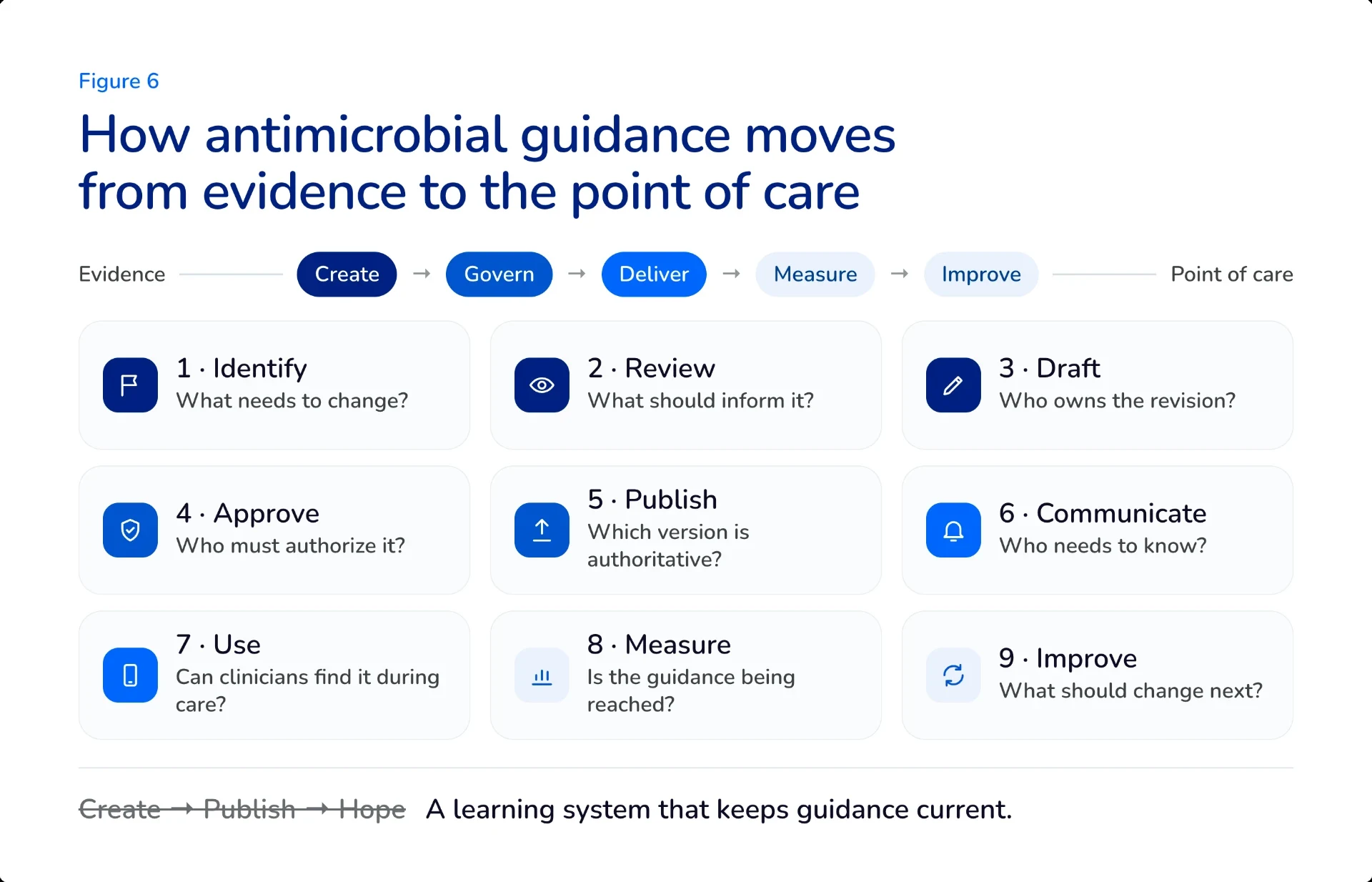
The most sustainable approach is to define an explicit lifecycle rather than relying on someone to remember when a document needs attention.
| Stage | Key question | Digital capability |
|---|---|---|
| Identify | What guidance needs to change? | Clinical feedback, search trends, usage data, evidence surveillance |
| Review | What should inform the change? | Evidence, microbiology data, antibiograms, formulary information |
| Draft | Who owns the revision? | Named content owner and collaborative editing |
| Approve | Who must authorize it? | Roles, permissions and governance workflow |
| Publish | Which version is authoritative? | Controlled publishing and version history |
| Communicate | Who needs to know? | Targeted updates and notifications |
| Use | Can clinicians find it during care? | Search, mobile/web access and AI-assisted retrieval |
| Measure | Is the guidance being reached? | Content and search analytics |
| Improve | What should change next? | Usage patterns, feedback and knowledge gaps |
A workflow like this turns stewardship content into a learning system.
Instead of:
Create → Publish → Hope
the model becomes:
Create → Govern → Deliver → Measure → Improve
Clinical reference tools and clinical knowledge platforms solve different problems
A clinical reference resource helps clinicians access externally developed medical evidence and recommendations.
A clinical knowledge platform helps a healthcare organization manage and deliver its own institutional knowledge.
These are not necessarily competing functions.
Hospitals may need both.
National evidence can help answer:
"What does the literature recommend?"
Local clinical knowledge needs to answer:
"What do we do here?"
For antimicrobial stewardship, that difference can be particularly important because prescribing decisions may depend on:
- Local susceptibility patterns
- Formulary availability
- Organizational policies
- Approved pathways
- Local laboratory capabilities
- Service-specific workflows
- Institutional restrictions
CDC stewardship guidance recognizes the importance of facility-specific treatment recommendations.
A digital antimicrobial stewardship strategy therefore needs to consider not only access to general medical knowledge but also the management of local clinical knowledge.
How should AI be used in antimicrobial stewardship?
AI is creating new possibilities for clinical knowledge retrieval, but it also makes governance more important.
For stewardship programs, several questions should come before the AI feature itself:
What sources can the system use?
Who controls those sources?
Can the clinician see where an answer came from?
What happens when the source material does not contain the answer?
How are updated guidelines reflected in future responses?
Can the organization audit and govern the underlying clinical content?
Retrieval-augmented systems offer one approach by grounding responses in a defined body of trusted institutional knowledge.
That architecture aligns naturally with antimicrobial stewardship because the stewardship team retains responsibility for the source content.
The AI layer improves retrieval.
It does not become the clinical authority.
What does the evidence say about AI-assisted antimicrobial guidance?
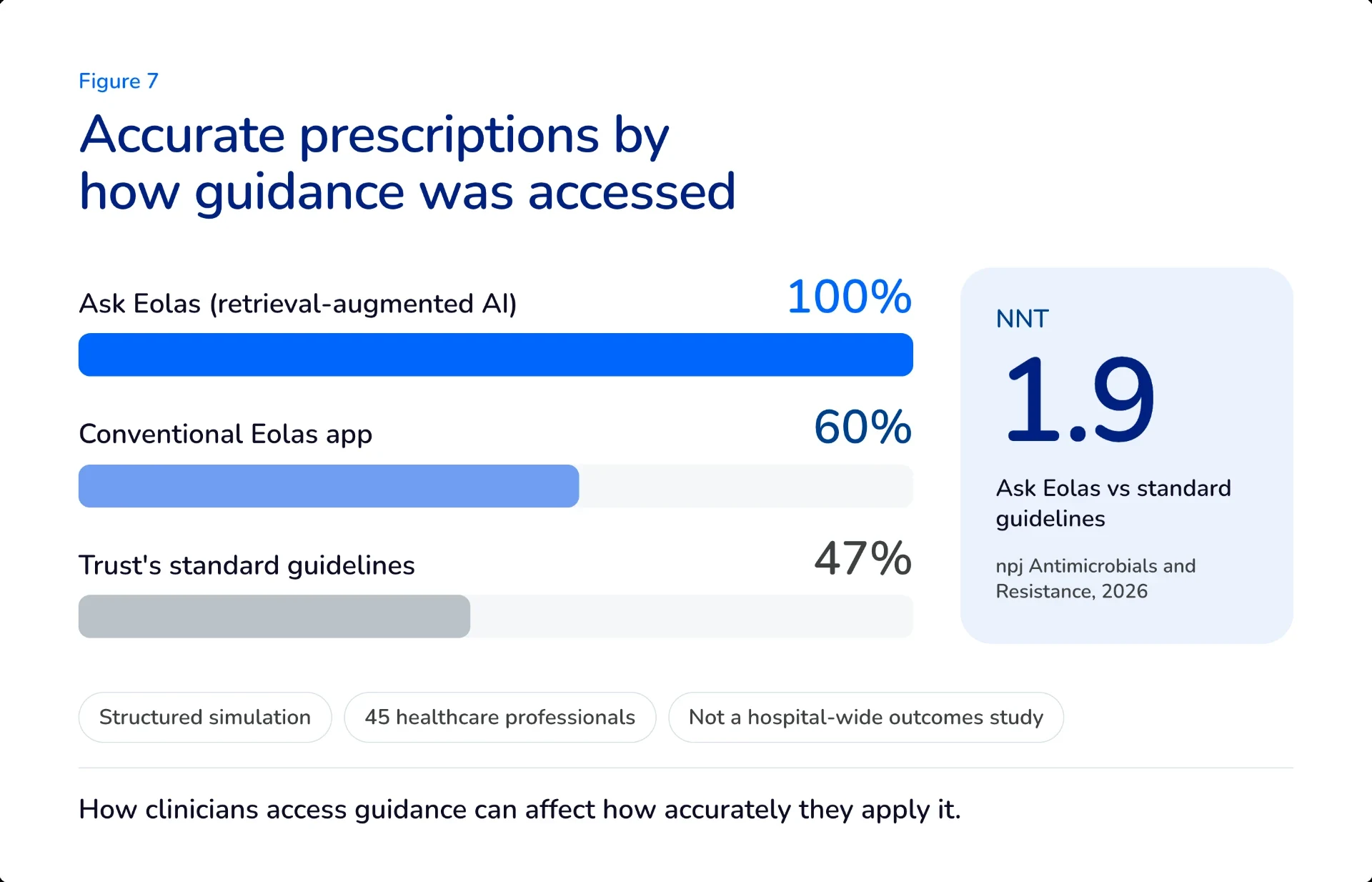
A 2026 peer-reviewed study published in npj Antimicrobials and Resistance evaluated Ask Eolas, a retrieval-augmented AI clinical decision-support system, in a structured prescribing simulation (Waldock et al., 2026). We cover this antimicrobial prescribing study in more detail separately.
The study involved 45 healthcare professionals across three approaches to accessing antimicrobial guidance.
Participants using Ask Eolas achieved 100% accurate prescriptions in the evaluated scenarios, compared with 60% using the conventional Eolas app and 47% using the Trust's standard guidelines.
The reported number needed to treat compared with the standard-guideline approach was 1.9.
Importantly, this was a structured, single-site simulation study, not a hospital-wide clinical outcomes trial.
Further real-world implementation research is therefore important.
That distinction matters.
The study should not be interpreted as evidence that AI alone solves antimicrobial stewardship.
It does, however, illustrate a broader point:
The way clinicians access and interrogate complex antimicrobial guidance can affect their ability to apply it accurately.
What does digital antimicrobial stewardship look like in practice?
The challenge becomes particularly visible in large health systems.
Carilion Clinic operates six hospitals and approximately 280 outpatient practices.
Its antimicrobial stewardship resources included treatment guidelines, dashboards, provider education, microbiology resources, and other materials that were not previously housed in a single location, with some resources sitting behind a firewall.
After implementing Eolas Medical to centralize those resources, Carilion Clinic reported a nearly four-fold increase in access to antimicrobial stewardship resources compared with the period before implementation.
That result is a measure of resource access rather than a direct clinical outcome.
But it highlights an important and often overlooked stewardship question:
Before measuring whether clinicians followed a guideline, do you know whether they were able to find it?
Access is not the endpoint of antimicrobial stewardship.
It is a prerequisite.
A checklist for evaluating digital antimicrobial stewardship platforms
When assessing a platform, stewardship and clinical pharmacy leaders can use the following questions.
Local clinical knowledge
Can it manage your organization's own guidelines, protocols, antibiograms, pathways, calculators, policies, and educational resources?
Governance
Can your organization define owners, editors, permissions, review responsibility, and approval processes?
Version control
Can clinicians identify the current resource without encountering multiple competing versions?
Findability
Can users find guidance without already knowing the exact document name or storage location?
Point-of-care access
Can clinicians reach the content through the devices and workflows they actually use?
Grounded AI
If AI is included, can answers be constrained to trusted content and connected back to their sources?
Communication
Can meaningful updates be communicated to the relevant clinicians?
Analytics
Can the stewardship team understand content usage, search behavior, and unmet knowledge needs?
Multi-site governance
Can enterprise standards coexist with appropriate hospital, department, or specialty variation?
Administration
Can clinical teams manage their own knowledge without requiring technical intervention for every update?
The goal is not to acquire more software.
It is to reduce friction between trusted antimicrobial guidance and the clinical decisions it is intended to support.
Where Eolas fits into digital antimicrobial stewardship
Eolas Medical is a clinical knowledge management platform designed to help healthcare organizations centralize and deliver their own institutional guidance.
For antimicrobial stewardship teams, that can include prescribing guidelines, antibiograms, resistance information, dosing resources, de-escalation protocols, pathways, educational materials, and other local stewardship content.
The platform supports centralized access to these resources, customizable stewardship spaces, mobile access, search, communication, and analytics around how clinicians engage with guidelines and protocols.
Ask Eolas adds a retrieval-augmented AI layer, described in our peer-reviewed evidence, designed to make that institutional knowledge easier to interrogate at the point of care.
The important distinction is that the stewardship team remains responsible for the knowledge itself.
Eolas helps make that knowledge easier to govern, distribute, find, and measure.
The future of antimicrobial stewardship is not human expertise versus technology
The more useful question is how technology can extend stewardship expertise.
Antimicrobial stewardship professionals are already responsible for an enormous body of work: evidence review, guideline development, audit and feedback, prescribing improvement, education, collaboration, measurement, and clinical consultation.
At the same time, those teams are expected to support increasingly complex healthcare environments across more clinicians, departments, facilities, and care settings.
Technology cannot replace that expertise.
But it can reduce some of the friction surrounding it.
When an antimicrobial recommendation can be:
updated once,
governed appropriately,
made available across the organization,
found at the moment of need,
connected to its source,
and measured after publication,
the guideline stops behaving like a static document.
It becomes part of the clinical workflow.
And that is the real opportunity of digital antimicrobial stewardship.
Frequently asked questions
What is digital antimicrobial stewardship?
Digital antimicrobial stewardship is the use of digital systems to support the creation, governance, distribution, discovery, application, and measurement of antimicrobial stewardship knowledge. It can include local guidelines, antibiograms, dosing resources, prescribing pathways, communication tools, analytics, and AI-supported clinical knowledge retrieval.
Which clinical knowledge platforms help pharmacy teams manage antimicrobial stewardship content?
The appropriate platform depends on an organization's requirements.
Clinical pharmacy teams evaluating digital antimicrobial stewardship platforms should look for capabilities such as local content management, permissions, version control, search, point-of-care access, communication, analytics, multi-site governance, and clear source attribution when AI is used.
Eolas Medical is one example of a clinical knowledge platform designed to centralize and deliver local antimicrobial stewardship resources while supporting search, mobile access, content management, communication, and analytics.
How do clinical pharmacists keep antimicrobial guidelines updated in digital platforms?
A sustainable process assigns ownership to each important resource, establishes review responsibility, defines who can approve changes, maintains version history, retires superseded guidance, publishes the authoritative version, communicates significant changes, and monitors how the updated resource is used.
The most effective approach treats clinical content updating as a continuous governance workflow rather than a periodic document-upload task.
What content belongs in an antimicrobial stewardship platform?
Depending on the organization, antimicrobial stewardship content may include local prescribing guidelines, antibiograms, renal dosing guidance, IV-to-oral criteria, restricted antimicrobial policies, therapeutic drug monitoring resources, allergy guidance, surgical prophylaxis recommendations, sepsis pathways, formulary information, microbiology resources, education, and other institutional protocols.
What is the difference between a clinical reference platform and a clinical knowledge platform?
Clinical reference platforms primarily provide externally developed medical information.
Clinical knowledge platforms help healthcare organizations govern and distribute their own local policies, guidelines, protocols, pathways, and other institutional knowledge.
For antimicrobial stewardship, both may be valuable because clinicians need access to the broader evidence base as well as facility-specific recommendations.
Can AI be used for antimicrobial stewardship?
AI can assist with antimicrobial stewardship when implemented with appropriate clinical governance.
Retrieval-augmented AI can search trusted organizational content and use that material to construct an answer with source attribution.
AI should support, rather than replace, antimicrobial stewardship expertise and clinical judgment.
What should a digital antimicrobial stewardship program measure?
Traditional antimicrobial stewardship metrics remain essential and may include antibiotic utilization, guideline concordance, prescribing patterns, treatment duration, resistance, intervention acceptance, and relevant patient outcomes.
Digital systems can complement those measures with information such as resource views, search activity, engagement with updated guidance, failed searches, and utilization by department or role.
Why is local antimicrobial guidance important?
National guidelines establish an important evidence base, but local treatment recommendations can incorporate factors such as resistance patterns, formulary decisions, available diagnostics, institutional policies, and local workflows.
CDC hospital stewardship guidance specifically emphasizes facility-specific treatment recommendations as part of effective implementation.
Make antimicrobial guidance easier to manage and easier to use
Your stewardship team already invests significant expertise in creating trusted, locally relevant clinical guidance.
The next challenge is making sure that knowledge stays current, governed, discoverable, and usable at the moment of care.
Eolas Medical gives healthcare organizations one place to manage and deliver local clinical knowledge, with tools for content governance, search, mobile access, analytics, communication, and source-grounded AI retrieval.
Sources and further reading
- CDC: Core Elements of Hospital Antibiotic Stewardship Programs
- CDC: Core Elements of Antibiotic Stewardship
- SHEA/SIDP/PIDS/IDSA: Guidance for the Knowledge and Skills Required for Antimicrobial Stewardship Leaders (2026)
- IDSA/SHEA: Implementing an Antibiotic Stewardship Program
- Waldock et al., npj Antimicrobials and Resistance, 2026
- Carilion Clinic antimicrobial stewardship case study
Related reading
Thought leadership
Clinical Policy Management: How to Make Healthcare Policies Easier to Find, Govern and Use
Learn what clinical policy management is, why traditional policy repositories fall short, and how healthcare organizations can make policies easier to govern, find and use.
Published

Thought leadership
Evidence is a lagging indicator: what the largest AI scribe study actually tells us
The biggest real world study of ambient AI scribes found modest time savings and no measurable change downstream. Why we think the evidence is lagging the technology, not contradicting it.
Published
Thought leadership
The Golden Triangle of Clinical AI
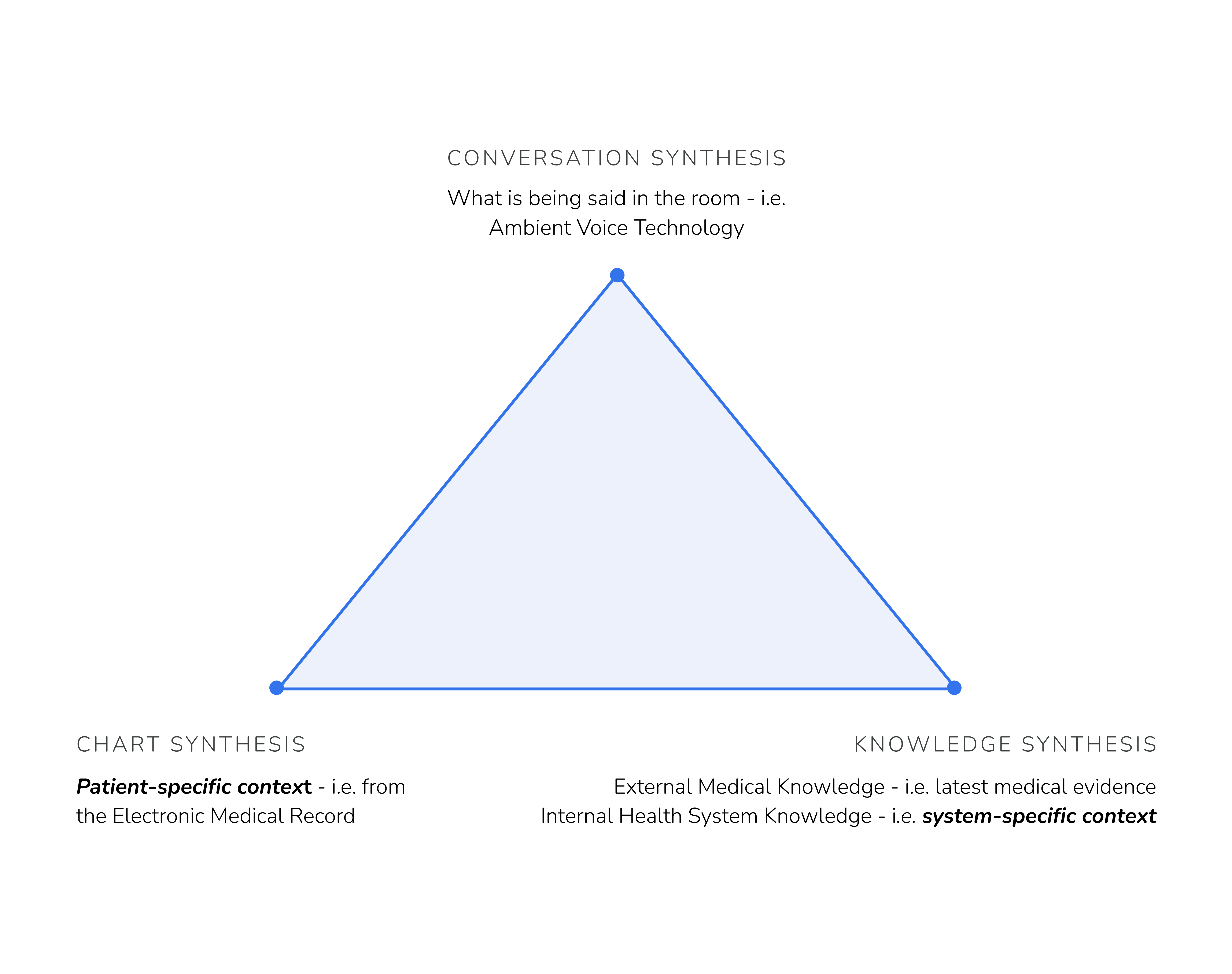
We've been diving into the three streams of synthesis converging at the moment of clinical decision and have written an article exploring each corner... Conversation Synthesis i.e what is being said in the room, Chart Synthesis i.e what is known about this patient and Knowledge Synthesis i.e both what medicine knows and how this health system practises. Each corner has its own category leaders. Each is at a different stage of maturity. Each has real limits. The integrated future of Clinical AI runs on all three.
Published