
Thought leadership
Clinical Policy Management: How to Make Healthcare Policies Easier to Find, Govern and Use
Learn what clinical policy management is, why traditional policy repositories fall short, and how healthcare organizations can make policies easier to govern, find and use.
Published
Healthcare organizations rarely have a shortage of policies.
The harder problem is making sure the right policy is current, approved, easy to find and usable when someone actually needs it.
Clinical policies, protocols, pathways, procedures and guidelines can live across shared drives, intranets, document management systems, departmental folders and individual teams. As health systems grow, keeping that knowledge governed and accessible becomes increasingly complex.
That is where clinical policy management comes in.
The short answer: What is clinical policy management?
Clinical policy management is the process of creating, reviewing, approving, maintaining, distributing and making clinical policies and procedures accessible across a healthcare organization.
Effective clinical policy management helps ensure that:
- There is a clearly identified current version of each policy.
- Policies have defined owners and review cycles.
- Previous versions remain controlled and traceable.
- Approved guidance is accessible to the right people.
- Staff can find relevant policies quickly.
- Organizations can understand how their clinical guidance is being accessed and used.
Traditional policy management has focused heavily on controlling the document lifecycle.
Modern clinical policy management must address another question too:
Can the person delivering care actually find the right guidance when they need it?
Key takeaways
- Healthcare policy management is more than document storage. It includes ownership, approvals, review cycles, version control, distribution and governance.
- Clinical policy management adds a point-of-care dimension. Clinical guidance must not only be controlled but also easy for clinicians to retrieve and use.
- A single source of truth matters. Duplicate, outdated or conflicting copies increase friction and make governance harder.
- Search is becoming a core policy-management capability. Clinicians frequently know the question they need answered without knowing the exact name of the policy containing the answer.
- AI can make approved policies more usable when answers remain grounded in trusted organizational content and traceable to their sources.
- Analytics can reveal whether policies are actually reaching practice. Search and usage patterns can expose information gaps, difficult-to-find guidance and opportunities for improvement.
What is healthcare policy management?
Healthcare policy management is the broader process an organization uses to create, approve, publish, distribute, review, update and retire policies and procedures.
A healthcare policy management system commonly supports:
- Centralized policy storage
- Policy creation and editing
- Review and approval workflows
- Policy ownership
- Version control
- Effective and review dates
- Staff distribution
- Acknowledgments or attestations
- Audit history
- Regulatory or accreditation documentation
- Reporting and analytics
For hospitals and health systems, these functions can span clinical, compliance, safety, operational and administrative policies.
Clinical policy management focuses specifically on the policies, protocols, procedures, pathways and related resources that guide clinical work.
Why is healthcare policy management so difficult?
The problem usually isn't that healthcare organizations don't have policies.
It's that the information can become fragmented.
A single health system may need to govern thousands of resources across:
- Hospitals
- Ambulatory sites
- Departments
- Service lines
- Specialty teams
- Quality and safety teams
- Pharmacy
- Nursing
- Infection prevention
- Emergency medicine
- Surgery
- Medical staff
- Education and training
The same clinical topic may appear in several different resources.
One hospital may maintain a procedure separately from another hospital in the same system.
A protocol may have been updated while an older copy remains on a shared drive.
A clinician may know the organization has guidance without knowing what the file is called or where it lives.
This creates four distinct policy-management challenges.
1. Policy sprawl
Policies become distributed across folders, systems, departments and locations.
2. Version uncertainty
Users may encounter several documents covering the same topic without immediately knowing which one is current.
3. Governance burden
Policy owners have to track reviews, approvals, revisions and publishing across an increasingly large library.
4. The policy accessibility gap
Even when a policy is properly governed, clinicians may struggle to find the information inside it.
That fourth challenge is particularly important in clinical environments.
A policy can be fully approved and technically available while still being difficult to use at the point of care.
What is the policy accessibility gap?
The policy accessibility gap is the difference between having an approved policy somewhere in the organization and making the information inside that policy easy to retrieve when staff need it.
Consider a clinician who needs to know:
- What is our current hypoglycemia protocol?
- When should this medication be held before surgery?
- What is our isolation guidance for this patient?
- What are the transfer criteria?
- Which antibiotic does our local guidance recommend?
- What steps are required in our massive transfusion protocol?
The clinician may not know the title of the document.
They may not know which department owns it.
They may not know whether the answer lives in a policy, protocol, pathway, table or antibiogram.
They simply know the question.
That means an effective clinical policy management strategy has to solve for both sides of the equation:
Governance: Is the information approved, current and controlled?
Access: Can the person who needs it actually find and use it?
Policy management vs. document management: What's the difference?
Document management and policy management overlap, but they solve different problems.
| Capability | Document management | Healthcare policy management | Clinical policy management |
|---|---|---|---|
| Store documents | ✓ | ✓ | ✓ |
| Search documents | ✓ | ✓ | ✓ |
| Version control | Sometimes | ✓ | ✓ |
| Policy ownership | ✓ | ✓ | |
| Review and approval workflows | ✓ | ✓ | |
| Review/expiration dates | ✓ | ✓ | |
| Audit history | Sometimes | ✓ | ✓ |
| Staff acknowledgment | Often | Often | |
| Natural-language clinical search | Sometimes | Increasingly important | |
| Search across policies, protocols and pathways | Sometimes | ✓ | |
| Point-of-care accessibility | Sometimes | ✓ | |
| Clinical knowledge analytics | ✓ |
A document management system answers:
Where is the file?
A policy management platform answers:
Is this the current, approved file and how is it governed?
A modern clinical policy management system should also help answer:
What does our approved guidance say about the question in front of me right now?
What does the clinical policy management lifecycle look like?
A traditional policy lifecycle might be represented as:
Create → Review → Approve → Publish → Update → Retire
For clinical guidance, that leaves out several critical steps.
A more complete lifecycle is:
Create → Review → Approve → Publish → Find → Use → Measure → Improve
Create
Policies and procedures are developed using organizational standards, subject-matter expertise and applicable requirements.
Review
Clinical, quality, compliance or operational stakeholders evaluate the content.
Approve
The appropriate owner or governance body authorizes the policy.
Publish
The current version becomes available across the organization.
Find
Staff must be able to retrieve the policy or relevant information quickly.
Use
The approved guidance becomes part of real clinical work.
Measure
Organizations can examine searches, policy usage and engagement.
Improve
Usage patterns, unanswered searches and changing clinical requirements help inform future updates.
This is the difference between treating policies as documents and treating them as living organizational knowledge.
What should healthcare organizations look for in policy management software?
Healthcare policy management software varies considerably, but there are several capabilities hospitals and health systems should evaluate.
Centralized policy management
The organization should have a clearly governed source of truth for policies, procedures, guidelines and protocols.
Version control
Users should be able to identify the current version, while administrators maintain appropriate historical records.
Policy ownership
Every policy should have an accountable owner or team responsible for keeping the content current.
Review and approval workflows
Organizations should be able to route policies through appropriate clinical, operational or compliance review without relying on disconnected email chains.
Review-cycle management
Teams need visibility into policies approaching review dates or requiring attention.
Staff distribution and acknowledgment
For policies requiring formal communication or attestation, organizations should be able to distribute updates and track acknowledgment.
Audit history
Organizations may need to establish which version of a policy was approved or active at a particular point in time.
Enterprise search
Users should be able to search across large policy libraries without already knowing the exact document name.
Natural-language search
Clinical users should be able to search the way they naturally think:
"What is our protocol for this?"
rather than:
"What folder contains policy CLN-472?"
Source-grounded AI
When AI is used to answer questions, responses should be based on approved organizational content and allow users to verify the underlying sources.
Multi-site governance
Large health systems need to distinguish system-wide guidance from facility-specific or departmental policies while preserving clear ownership.
Analytics
Organizations should be able to understand which policies are used, which topics clinicians search for and where knowledge gaps may exist.
How should you evaluate clinical policy management software?
Instead of comparing products only by the number of features they advertise, healthcare organizations can use a practical evaluation framework.
Ask:
Governance
- Can we identify a policy owner?
- Can we configure review and approval processes?
- Can we clearly distinguish current and historical versions?
- Can we identify policies approaching review?
Accessibility
- Can a frontline clinician find the right guidance quickly?
- Does search work across the full content of documents?
- Does the user need to know the document title first?
- Is access available where clinicians work?
Clinical usability
- Can users search using natural-language questions?
- Can the platform search across protocols, pathways, policies, tables and other formats?
- Can answers link back to the source material?
Enterprise scalability
- Can we manage system-wide and site-specific content?
- Can responsibility be distributed to appropriate clinical owners?
- Can access be organized by team, service line or location?
Measurement
- Can we see what users are searching for?
- Can we identify high- and low-use resources?
- Can we see where clinicians search but fail to find an answer?
- Can those insights inform future policy development?
Compliance and audit support
- Can the organization demonstrate the policy lifecycle?
- Are historical versions available when required?
- Can teams document review, approval and distribution?
- Can the system support the organization's applicable accreditation and regulatory processes?
CMS Conditions of Participation establish health and safety requirements that participating healthcare organizations must meet, while accreditation organizations such as The Joint Commission maintain additional standards and survey processes. Policy-management requirements therefore need to be considered within each organization's specific regulatory and accreditation environment.
How is AI changing healthcare policy management?
AI has the potential to change policy management in two major areas.
AI for policy governance
AI can assist policy-management teams by helping identify:
- Potentially duplicated content
- Contradictory guidance
- Similar policies
- Outdated resources
- Content requiring review
Humans still remain responsible for approving organizational clinical guidance.
AI for policy discovery
AI can also help clinicians retrieve information from approved policies using natural-language questions.
This is particularly useful because clinical questions frequently cross document boundaries.
For example, the answer to one clinical question might involve information contained in:
- a medication policy;
- a clinical pathway;
- a local protocol; and
- an antibiogram.
Rather than asking a user to manually locate and cross-reference each resource, a grounded AI system can help surface the relevant information and provide links or citations to its sources.
The important distinction is this:
AI should make governed knowledge easier to retrieve, not become an uncontrolled source of new clinical policy.
What is grounded AI for clinical policies?
Grounded AI generates responses using a defined set of trusted source materials rather than relying solely on the model's general knowledge.
For clinical policy management, those sources might include an organization's:
- Clinical policies
- Procedures
- Guidelines
- Protocols
- Pathways
- Formularies
- Antibiograms
- Educational resources
A well-designed system should make it easy for the user to see which approved resources support an answer.
That traceability is particularly important in clinical environments.
Why policy search matters at the point of care
Healthcare policies are often written and organized for governance.
Clinicians search based on patient care.
Those are not always the same information architecture.
An administrator may organize a policy as:
Medication Management → Antimicrobial Stewardship → Adult Sepsis Guideline
A clinician may simply search:
"What antibiotics do we use for suspected sepsis?"
Modern clinical policy management should bridge those two ways of interacting with information.
This is why full-text search is useful, but natural-language, source-grounded retrieval can go further.
The objective is not simply to make documents searchable.
It is to make the knowledge contained inside them retrievable.
What are the benefits of effective clinical policy management?
A single source of truth
A clearly governed repository helps reduce uncertainty around which policy or protocol is current.
Faster access to guidance
Clinicians spend less time navigating folders, intranets and lengthy documents.
More consistent governance
Defined owners and review cycles help organizations maintain policies systematically.
Better visibility
Analytics can show which resources are used and what clinicians are looking for. For examples of how healthcare organizations are measuring the impact of easier access to clinical knowledge, explore the Eolas evidence.
Easier identification of knowledge gaps
Repeated searches that fail to produce useful results may indicate that guidance is missing, unclear or difficult to locate.
Better connection between policy and practice
Ultimately, the purpose of a clinical policy is not simply to exist.
It is to inform practice.
How can healthcare organizations improve clinical policy management?
Technology alone does not solve policy sprawl.
Before implementing or expanding a policy-management system, organizations should consider several foundational steps.
1. Audit the existing policy library
Identify:
- Duplicate policies
- Historical copies
- Conflicting guidance
- Content without a clear owner
- Policies past their expected review date
- Resources stored outside the primary system
2. Establish clear ownership
Every important policy should have an identifiable clinical or organizational owner.
3. Standardize metadata
Use consistent naming, categories, service lines, effective dates, owners and review information.
4. Separate system-wide and local guidance
Health systems should clearly distinguish enterprise standards from site-specific variations.
5. Design search around users
Do not assume clinicians know the organization's folder structure.
Test the system using the questions clinicians actually ask.
6. Measure policy usage
Look beyond whether a policy has been published.
Evaluate whether people can find it and whether important clinical resources are actually being used.
7. Use search behavior as feedback
The questions clinicians ask can tell organizations something valuable about their knowledge environment.
Frequent searches may reveal high-value topics.
Failed searches may expose gaps.
Repeated questions about a difficult-to-find policy may signal an accessibility problem.
Clinical policy management can therefore become a feedback loop rather than a one-way publishing process.
Healthcare policy management and survey readiness
Policy management also plays an important role in regulatory and accreditation readiness.
CMS Conditions of Participation apply to hospitals and numerous other provider types participating in Medicare and Medicaid. The Joint Commission similarly incorporates organizational policies and procedures into its accreditation ecosystem and publishes resources specifically addressing their development and management.
For healthcare organizations, survey readiness can require more than demonstrating that a policy exists.
Teams may need to establish:
- Which policy was current
- Who owned or approved it
- When it was reviewed
- How revisions were controlled
- How staff access or communication was managed
This makes governance, accessibility and documentation interconnected parts of a strong policy-management strategy.
From policy repository to clinical knowledge system
For years, policy management has largely been treated as a document-management problem:
Write it. Approve it. Store it. Update it.
That model is changing.
Healthcare organizations increasingly have the opportunity to treat their approved content as a connected clinical knowledge system.
Instead of asking clinicians to navigate the organization's filing structure, that knowledge can become accessible through the questions clinicians naturally ask.
The policy remains the source of truth.
The way people interact with the policy becomes easier.
The model shifts from:
policy repository
to:
governed clinical knowledge layer
where:
policies + protocols + pathways + guidelines + search + AI + analytics
work together.
How Eolas supports clinical policy management
Eolas helps healthcare organizations centralize the clinical knowledge they already own and make it easier to govern, find and use.
Organizations can bring together policies, protocols, guidelines, pathways, education and other institutional resources within a searchable clinical knowledge environment.
For administrators and clinical leaders, that means maintaining governed organizational knowledge while gaining greater visibility into how it is used.
For frontline clinicians, it means being able to search institutional guidance using the questions they actually have rather than needing to know where a particular document lives.
With source-grounded AI, clinicians can receive answers based on approved organizational content with references back to the underlying material.
The result is a different approach to clinical policy management:
Don't just manage the policy. Make the knowledge inside it usable.
Frequently asked questions about healthcare policy management
What is healthcare policy management?
Healthcare policy management is the process of creating, reviewing, approving, publishing, distributing, updating and retiring healthcare policies and procedures. It also includes governance functions such as ownership, version control, review schedules and audit history.
What is clinical policy management?
Clinical policy management focuses specifically on policies, protocols, procedures, guidelines and pathways related to patient care. Modern clinical policy management also considers how clinicians find and use approved guidance at the point of care.
What is healthcare policy management software?
Healthcare policy management software provides a centralized system for managing policies throughout their lifecycle. Common capabilities include version control, review workflows, approvals, ownership, distribution, acknowledgments, audit trails and reporting.
What is the difference between policy management and document management?
Document management primarily focuses on storing and organizing files. Policy management adds governance, including ownership, approvals, review cycles, version control and documentation of the policy lifecycle.
What features should healthcare policy management software have?
Healthcare organizations should consider centralized content management, version control, policy ownership, configurable workflows, review tracking, enterprise search, historical records, role-based access, reporting and, where appropriate, staff acknowledgment capabilities.
For clinical environments, natural-language search, source-grounded AI and knowledge-usage analytics may also be valuable.
Why is clinical policy management important?
Clinical policy management helps healthcare organizations keep approved guidance current, controlled and accessible. It can also reduce friction between publishing a policy and making that policy available to the people responsible for using it.
Can AI be used for clinical policy management?
Yes. AI can assist with policy search, content organization, duplicate detection and other policy-management tasks. In clinical environments, AI-generated answers should remain grounded in trusted organizational resources and allow users to verify their sources.
What is AI-powered policy search?
AI-powered policy search allows users to ask natural-language questions against an organization's policy library. A grounded system can identify relevant information within approved documents and return an answer with references to the underlying sources.
How do hospitals keep policies and procedures current?
Hospitals typically establish policy owners, review cycles, approval processes, version controls and publishing procedures. Policy management software can help automate parts of this process and make overdue reviews or outdated content easier to identify.
How can hospitals make policies easier for clinicians to find?
Hospitals can centralize clinical resources, standardize metadata, improve full-text search, provide access across appropriate devices and allow clinicians to search using natural-language questions rather than relying exclusively on document titles and folder structures.
Clinical policy management should connect governance with use
The success of a clinical policy should not be measured only by whether it was written, approved and stored correctly.
A more meaningful question is:
When someone needs that guidance, can they find it?
Effective clinical policy management connects the administrative side of policy governance with the clinical reality of policy use.
That means keeping guidance:
current, controlled, searchable, traceable and accessible.
Healthcare organizations already possess enormous amounts of clinical knowledge.
The opportunity is to make that knowledge easier to use.
See how Eolas can turn your organization's policies, protocols, pathways and guidelines into searchable, governed clinical knowledge.
Explore Eolas for healthcare organizations or talk to our team.
Related reading
Thought leadership
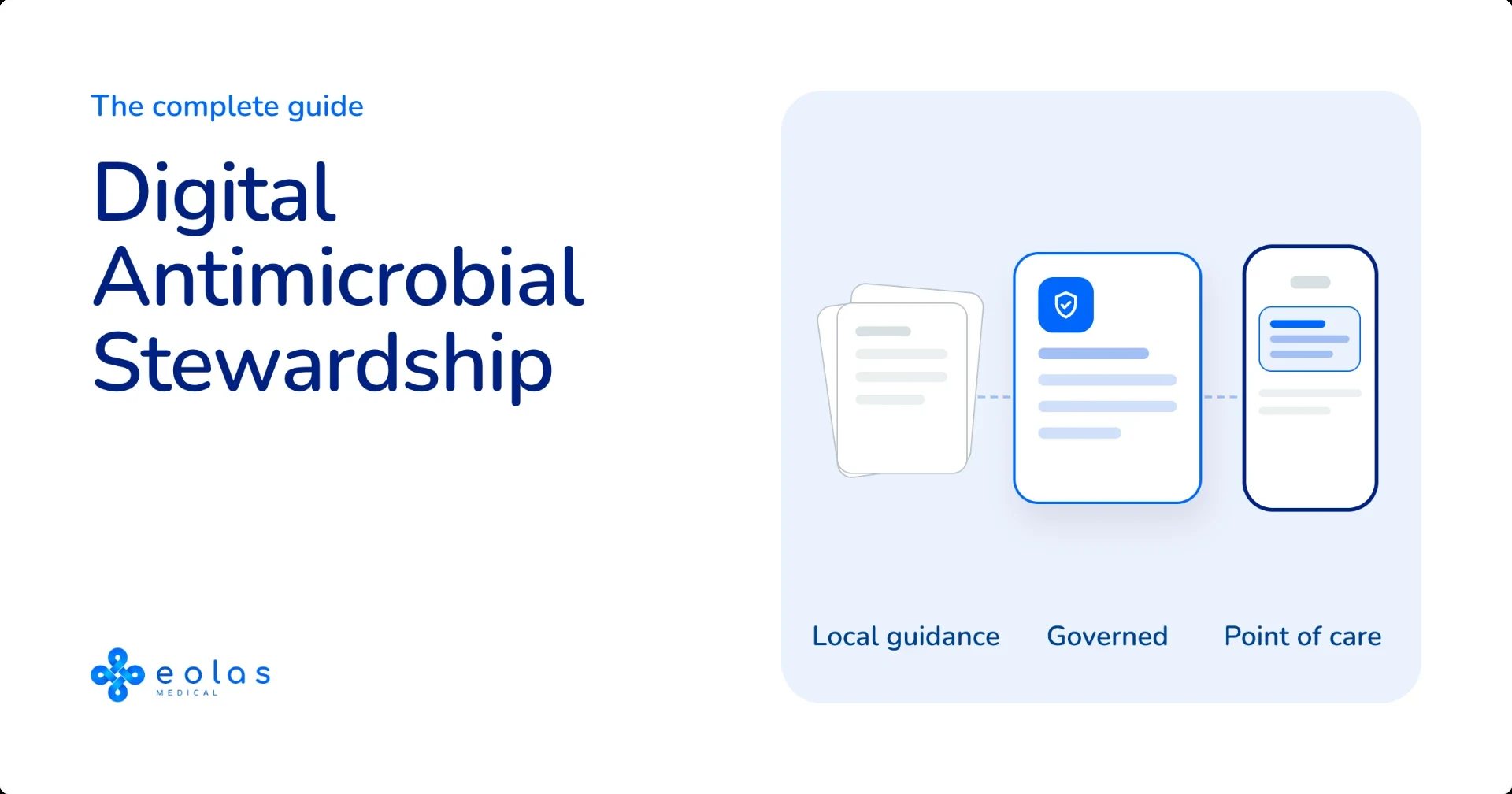
The Complete Guide to Digital Antimicrobial Stewardship
A practical guide for clinical pharmacy and antimicrobial stewardship teams on governing local guidelines, improving point-of-care access, and building a modern digital stewardship program.
Published

Thought leadership
Evidence is a lagging indicator: what the largest AI scribe study actually tells us
The biggest real world study of ambient AI scribes found modest time savings and no measurable change downstream. Why we think the evidence is lagging the technology, not contradicting it.
Published
Thought leadership
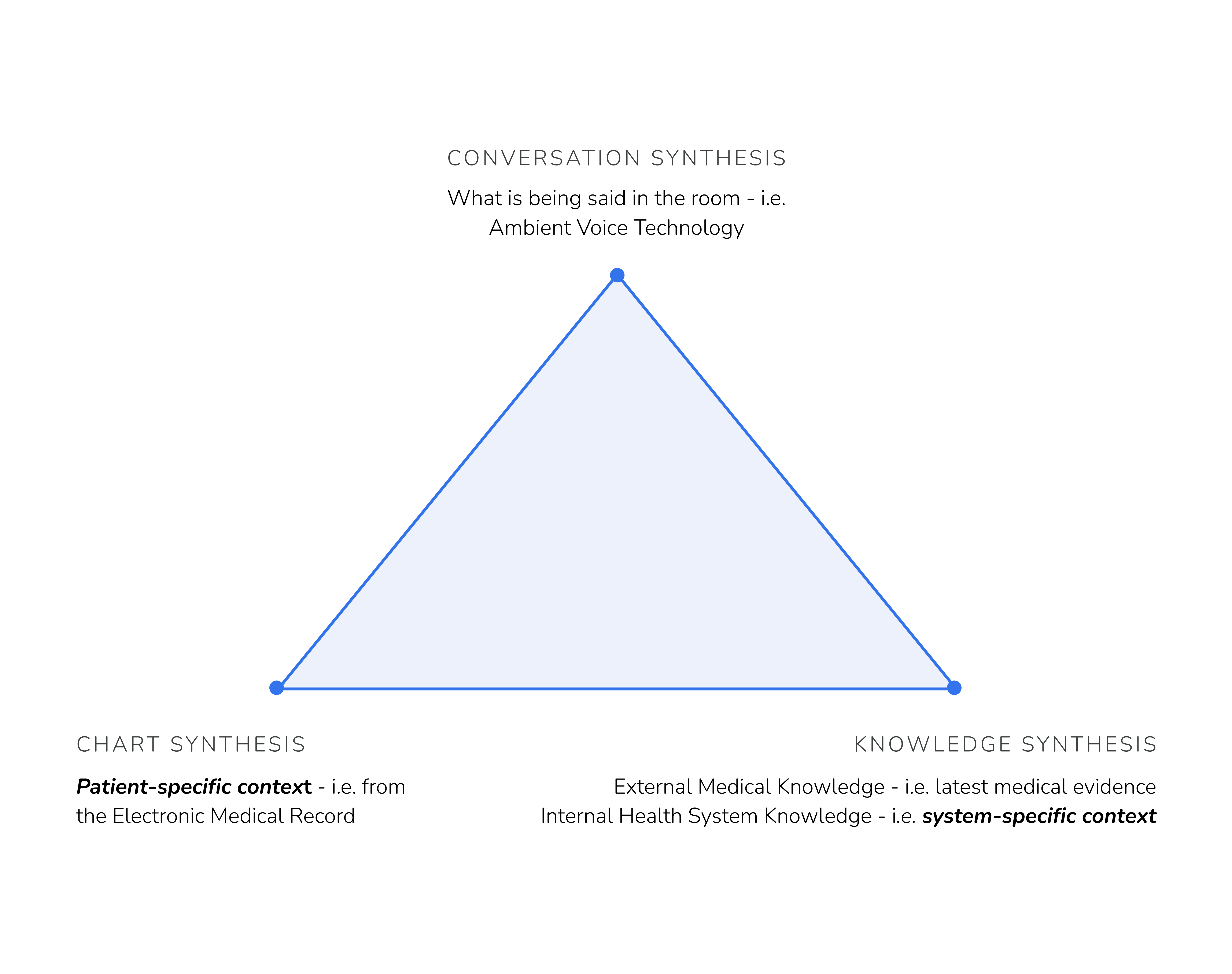
The Golden Triangle of Clinical AI
We've been diving into the three streams of synthesis converging at the moment of clinical decision and have written an article exploring each corner... Conversation Synthesis i.e what is being said in the room, Chart Synthesis i.e what is known about this patient and Knowledge Synthesis i.e both what medicine knows and how this health system practises. Each corner has its own category leaders. Each is at a different stage of maturity. Each has real limits. The integrated future of Clinical AI runs on all three.
Published