
Thought leadership
Stewardship fails at the point of decision
Choosing the familiar drug takes seconds. Stewardship wins when choosing the right one takes no longer.
Yosola Ibitoye
Published
“Let’s prescribe Tazocin because it’s my favourite”
A real sentence from a colleague prescribing antibiotics for a patient. This clearly highlights how antimicrobial stewardship is designed in committees and decided in consulting rooms.
Picture a busy clinic or the middle of the night on a hospital ward where a complex patient spikes a fever and has a raised white cell count again but the cultures are still pending. The right guideline exists somewhere, but finding it may mean a login, a search and a 60-page PDF that may be two revisions old. Prescribing a familiar broad-spectrum antibiotic takes ten seconds and feels safe.
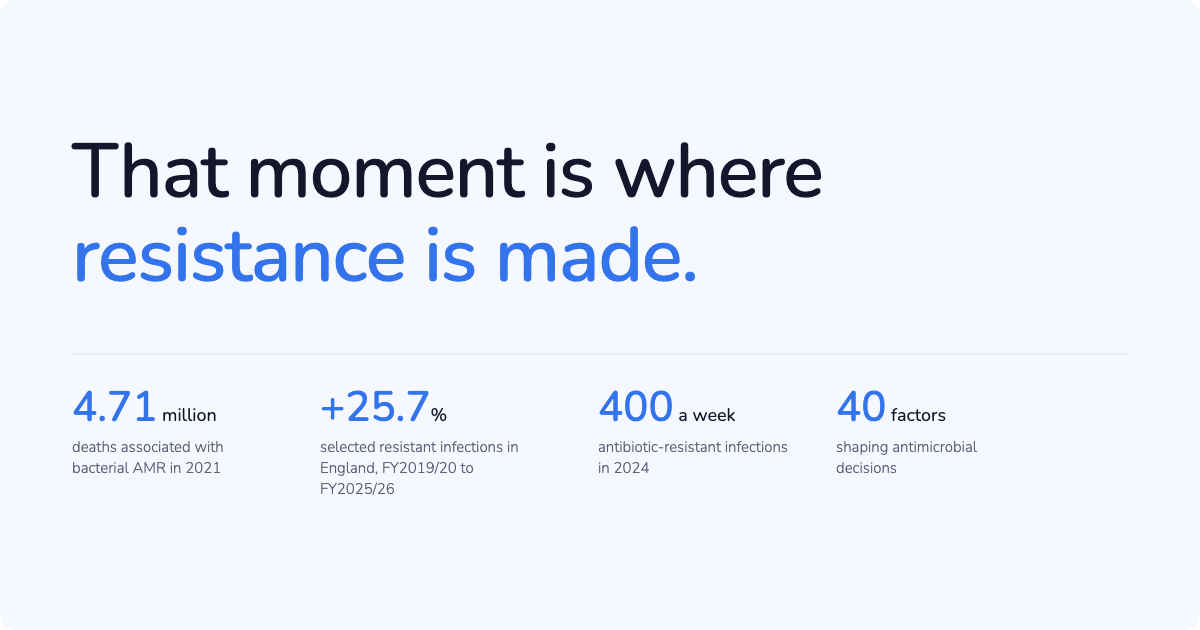
That moment is where resistance is made.
Why decisions go wrong
Resistance is not driven by rare errors. It is driven by ordinary, well-meant prescribing. WHO estimates that 4.71 million deaths were associated with bacterial AMR in 2021, and the evidence on prescribing quality shows how much of the pressure behind that figure is avoidable.
In the UK, resistance is moving the wrong way. Selected resistant infections in England rose 25.7% between FY2019/20 and FY2025/26, from 9,922 to 12,470, against a target of no increase. UKHSA's wider count was nearly 400 antibiotic-resistant infections a week in 2024.
Despite the unfavourable thought process my opening sentence may have evoked, prescribers are not careless. A British Journal of Clinical Pharmacology 2025 systematic review of 53 qualitative studies from 23 countries found 40 factors shaping antimicrobial decisions. The most common were time pressure, patient or carer demand, diagnostic uncertainty, clinical experience, and the use of guidelines and diagnostic tests. A 2024 European review of 35 articles also named uncertainty management as the key determining factor, alongside time constraints and diagnostic resources.
The 2025 review also found something stewardship messaging tends to skip: clinicians judged the harm of underprescribing, to the patient and to themselves, as outweighing the population harm of resistance. At the bedside, that is a rational weighing, not a knowledge gap.
This matters because most stewardship effort works on knowledge and attitudes, through education and policy. The dominant drivers are properties of the moment: how little time there is, how uncertain the diagnosis is, and what is within reach. When the safest-feeling option is also the fastest, it wins.
This is not simply a question of individual prescribing behaviour. Healthcare organisations need to consider where their clinical knowledge infrastructure makes the right decision accessible, current and practical at the point of care.
The design question is therefore not "how do we persuade clinicians?" It is "how do we make the right choice the easiest one at the point of decision?"
What good looks like
Stewardship at the point of decision does not mean a pop-up in the prescribing system on every prescription. The evidence points to three design principles.
- Make the right answer the fastest one. Current, local guidance should be findable in seconds, in the clinician's workflow, not in a separate system.
- Enable first, restrict sparingly. Enabling interventions were better accepted and boosted restriction in this Cochrane review.
- Show clinicians their own data. Feedback was the mechanism in an English GP trial and one of the most effective techniques in hospitals.
The lesson for any tool is to prove that clinicians open it at the moment of prescribing, and that prescribing changes when they do.
Choosing the familiar drug takes seconds. Stewardship wins when choosing the right one takes no longer. Clinicians already know resistance matters; what they lack, in the minutes that count, is the right guidance, their own data and the time to use them. This World AMR Awareness Week, the question for every stewardship programme is not what clinicians know, but what the next prescriber will see, and whether it arrives before the habit does.
Related reading
Thought leadership
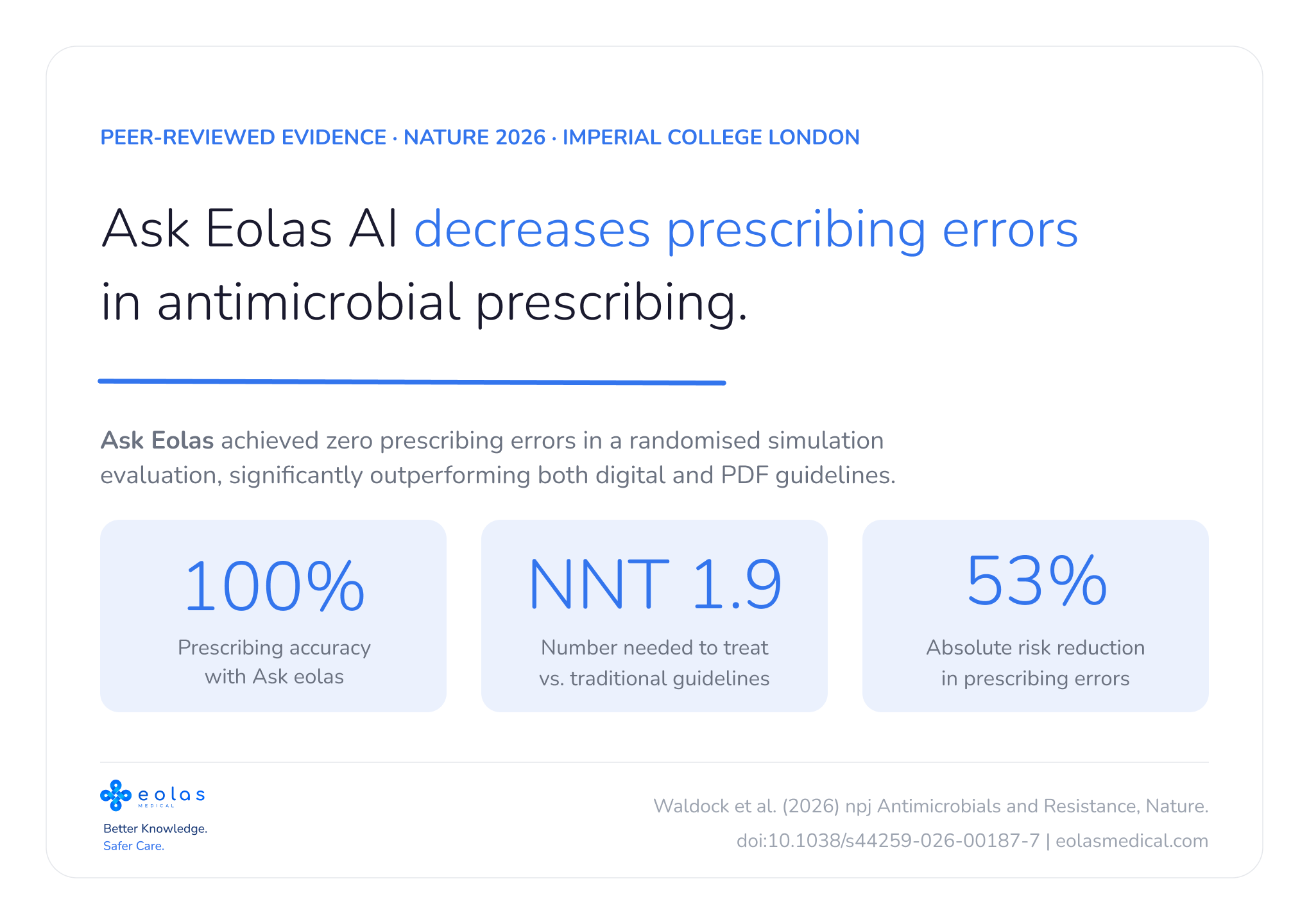
Zero Antimicrobial Prescribing Errors: What a Nature-Published Study Means for the AI and the Future of Antimicrobial Stewardship
Antimicrobial resistance is accelerating. The tools clinicians use to fight it haven’t kept pace — until now
Published

Thought leadership
Evidence is a lagging indicator: what the largest AI scribe study actually tells us
The biggest real world study of ambient AI scribes found modest time savings and no measurable change downstream. Why we think the evidence is lagging the technology, not contradicting it.
Published

Thought leadership
From Heuristics to Transformers: The Shift in Knowledge Representation
How LLMs are reshaping medical knowledge - from rigid rules to real-time, adaptive decision support.
Published