Thought leadership
Zero Antimicrobial Prescribing Errors: What a Nature-Published Study Means for the AI and the Future of Antimicrobial Stewardship
Antimicrobial resistance is accelerating. The tools clinicians use to fight it haven’t kept pace — until now
Published Updated
Antimicrobial resistance is accelerating. The tools clinicians use to fight it haven’t kept pace — until now. A new peer-reviewed study published in npj Antimicrobials and Resistance (Nature) by researchers at Imperial College London has demonstrated that Ask Eolas - an AI-powered clinical decision support system can eliminate antimicrobial prescribing errors in a controlled simulation environment.
For antimicrobial stewardship teams, infection pharmacists, and clinical leaders, these findings represent a significant step forward in the evidence base for AI in prescribing. Here’s what the study found, what it means, and why it matters for your stewardship programme.
The problem: guidelines exist, but errors persist
Every hospital has antimicrobial prescribing guidelines. The problem isn’t the quality of those guidelines — it’s how clinicians access them. In practice, prescribers navigate dense PDF documents, multi-page flowcharts, and nested tables under time pressure. The result is predictable: misinterpretation, missed nuances, and prescribing errors that drive inappropriate broad-spectrum antibiotic use.
This isn’t a knowledge problem. It’s a usability problem. Clinicians know what the right answer should look like. They just can’t always extract it from the tools available to them quickly enough, or accurately enough, when it matters.
The Imperial study quantified this gap directly. When healthcare professionals were given standard hospital PDF guidelines to work through a prescribing scenario, only 47% achieved an accurate prescription. The most common errors? Incorrect dose and incorrect duration — driven by misinterpretation of complex document layouts.
The study: a head-to-head comparison across three tools
Waldock et al. designed a structured, three-phase simulation evaluation testing 45 healthcare professionals — consultants, pharmacists, registrars, foundation doctors, core trainees, and prescribing nurses — across progressively complex antimicrobial prescribing cases at a major London teaching hospital.
Participants were randomly allocated to one of three intervention arms:
- Trust PDF Guidelines (standard practice) — static PDF documents accessed via the hospital intranet. This is what most clinicians use today.
- Eolas App (structured digital access) — the Eolas Medical mobile app, providing guideline access organised by body system and clinical pathway.
- Ask Eolas (AI-powered CDSS) — a retrieval-augmented generation (RAG) enhanced natural language interface, grounded exclusively in the hospital’s own antimicrobial guidelines, with source citations and clinical rationale displayed alongside every recommendation.
Prescribing accuracy was assessed across five domains: antibiotic selection, route of administration, dosage, treatment duration, and consideration of local microbiology and resistance patterns. Any error in any domain counted as an inaccurate prescription.
The headline results
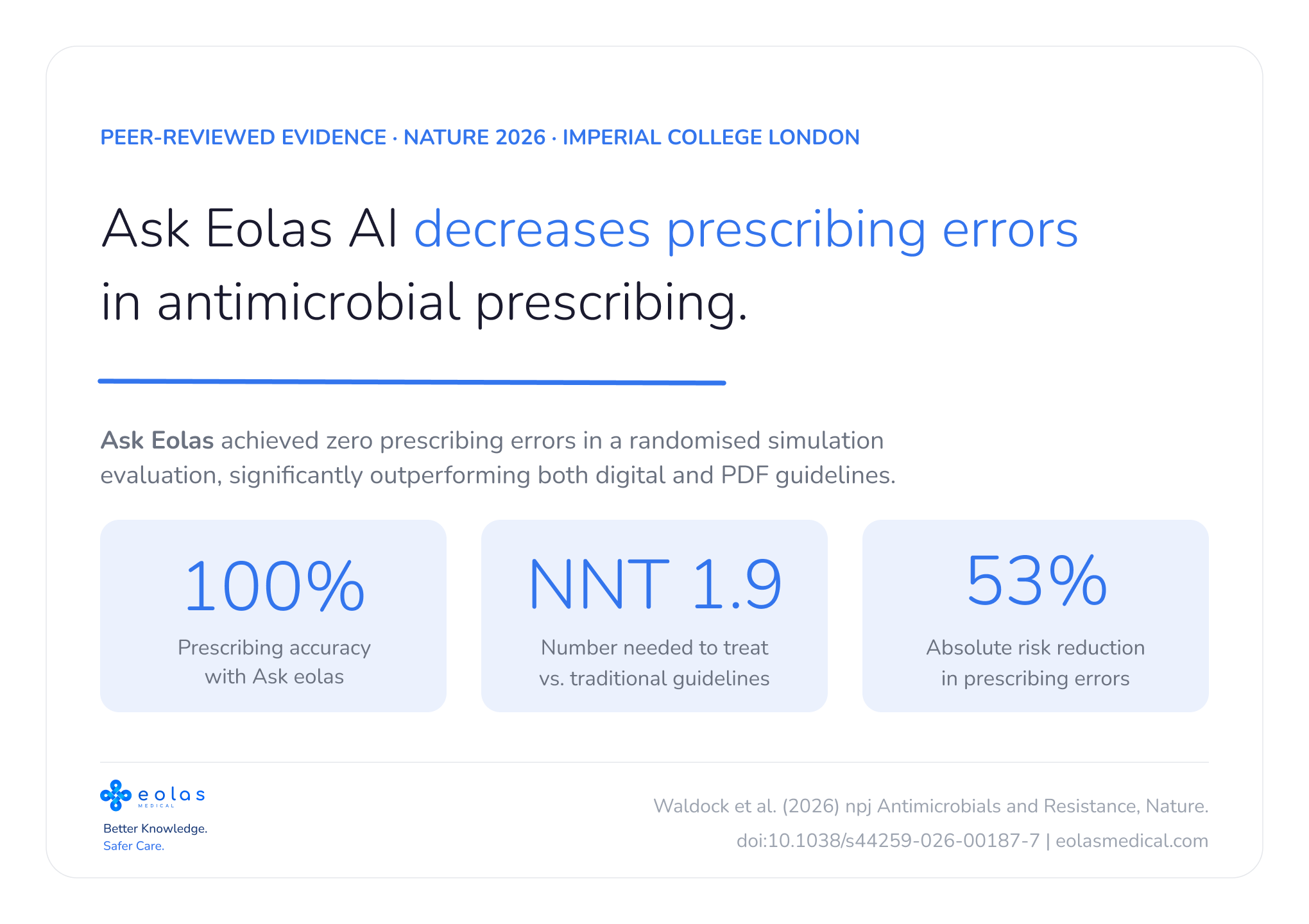
100% -Prescribing accuracy with Ask Eolas
NNT 1.9 vs. traditional guidelines
53% - Absolute risk reduction in errors
The results were striking. Ask Eolas achieved 100% prescribing accuracy (15 out of 15 participants), compared with 60% for the Eolas App and 47% for Trust PDF Guidelines. Fisher’s exact test confirmed the difference was statistically significant (p < 0.001).
The number needed to treat (NNT) was 1.9, meaning that for every two clinicians switching from traditional PDF guidelines to Ask Eolas, one additional error-free prescription results — per clinical case. In stewardship terms, that’s an extraordinary efficiency ratio.
Beyond accuracy: usability, confidence, and cognitive load
Prescribing accuracy was the primary outcome, but the secondary findings are equally telling for anyone thinking about implementation.
Clinician confidence was highest with Ask Eolas, with a median self-reported prescribing confidence score of 94 out of 100, compared to 72 for the Eolas App and 68 for PDF Guidelines.
Cognitive workload, measured via the NASA Task Load Index (NASA-TLX), was dramatically lower with Ask Eolas across all domains: mental demand, time pressure, effort required, and frustration. Participants using PDF Guidelines described them as “time-consuming and hard to pinpoint guidance,” particularly for complex clinical cases.
System usability scores consistently favoured Ask Eolas across all ten SUS components. Participants rated it highest for ease of use (4.9 out of 5) and user confidence (4.8 out of 5), while scoring it lowest on complexity (1.0 out of 5) and cumbersomeness (1.3 out of 5).
One clinician noted that the system’s direct links to source guidelines “helped me trust the answer.” Another observed that Ask Eolas “understood patient context and offered tailored suggestions.” These aren’t just usability metrics — they’re signals of trust, which is the single most important predictor of whether clinicians will actually adopt a new tool.
How Ask Eolas works: RAG, not generic AI
Ask Eolas is not ChatGPT for prescribing. It’s a fundamentally different architecture. The system uses retrieval-augmented generation (RAG) to anchor every recommendation exclusively in the hospital’s own approved antimicrobial guidelines. When a clinician asks a question, Ask Eolas:
- Retrieves the most relevant extracts from the hospital’s guideline library
- Synthesises them into a concise, natural-language recommendation
- Cites the source — every output links directly to the relevant guideline section, so clinicians can verify the recommendation themselves
This means the system doesn’t generate answers from general medical knowledge or training data. It delivers your guidelines, from your hospital, in plain language — with the receipts attached. For stewardship pharmacists, this is the critical distinction. You’re not trusting a black box. You’re trusting your own guidelines, made accessible through a better interface.
What this means for antimicrobial stewardship programmes
If you’re an AMS pharmacist or stewardship lead, here’s the practical translation of these findings:
- Guideline concordance can be dramatically improved without changing the guidelines themselves. The problem isn’t what’s in your guidelines — it’s how they’re delivered. Ask Eolas eliminates the interpretation gap between what the guideline says and what the prescriber understands, particularly for complex nested protocols where dose, duration, and route all depend on multiple patient factors.
- Broad-spectrum antibiotic use can be reduced at the point of prescribing. Errors in dose and duration are two of the primary drivers of inappropriate broad-spectrum use. When clinicians get the right answer first time — right drug, right dose, right duration, right route — they’re less likely to default to broad-spectrum cover as a safety net. The 53% absolute risk reduction in prescribing errors is a direct proxy for reduced inappropriate broad-spectrum prescribing.
- Stewardship teams can scale their impact without scaling headcount. The NNT of 1.9 means the tool’s effect is felt at the individual prescriber level. Every clinician who uses Ask Eolas instead of navigating a PDF becomes measurably more accurate. That’s a force multiplier for stewardship programmes that are typically under-resourced relative to the volume of prescribing decisions they’re trying to influence.
- Trust and transparency are built into the system, not bolted on. The study authors propose a TRUST-AI framework (Transparency, Real-time data integration, Usability, Stewardship and safety, Triage and confidence calibration, Accountability and auditability, Implementation and interoperability) as a structured approach to safe AI-CDSS deployment. Ask Eolas already embeds several of these principles: source citations, audit logging, and explainable outputs designed to build clinician trust rather than replace clinical judgement.
An honest reading: limitations and next steps
The study authors are transparent about what this is and what it isn’t. This was a single-site simulation evaluation with 45 participants. It was not a real-world implementation study, and the results should be interpreted as early-phase evidence — promising, rigorous, and hypothesis-generating, but not yet generalisable.
The authors also note that Ask Eolas in its current form does not incorporate real-time microbiology data, pharmacokinetic/pharmacodynamic parameters, or live resistance surveillance. These are future development priorities that would further personalise recommendations.
What the study does demonstrate is that the core RAG architecture works: it retrieves the right guideline content, synthesises it accurately, and delivers it in a way that eliminates errors and builds clinician confidence.
Looking ahead
This study represents the first time a RAG-enhanced AI clinical decision support tool for antimicrobial prescribing has been rigorously evaluated and published in a Nature-family journal. It’s an important milestone — not just for Eolas Medical, but for the broader case that AI can be deployed safely and effectively in high-stakes clinical environments.
For stewardship pharmacists and infection leads, the question is shifting from “Should we use AI?” to “How do we implement AI responsibly, with evidence, and with clinician trust at the centre?”
We think that’s exactly the right question. And the evidence is starting to provide answers.
Reference
Waldock, W.J., Gilchrist, M., Ashrafian, H., Darzi, A. & Dean Franklin, B. (2026). Enhancing quality of antimicrobial prescribing through ‘Ask Eolas’ (language model): a user-testing and simulation evaluation. npj Antimicrobials and Resistance, 4, 16. doi:10.1038/s44259-026-00187-7
Want to see how Ask Eolas can support your stewardship programme?
Visit https://eolasmedical.com/platform/antimicrobial-stewardship or get in touch at hello@eolasmedical.com
Related reading

Thought leadership
Evidence is a lagging indicator: what the largest AI scribe study actually tells us
The biggest real world study of ambient AI scribes found modest time savings and no measurable change downstream. Why we think the evidence is lagging the technology, not contradicting it.
Published

Thought leadership
From Heuristics to Transformers: The Shift in Knowledge Representation
How LLMs are reshaping medical knowledge - from rigid rules to real-time, adaptive decision support.
Published
Thought leadership
Pharma’s invisible content problem. Clinicians have moved on. The Industry hasn’t - and why GEO is the conversation we should all be having
How clinicians are accessing medical knowledge is changing from traditional search to AI based search, why is this important for industry?
Published