Thought leadership
Eolas vs Alternative Solutions: A Better Approach to Clinical Knowledge Management
Compare Eolas with SharePoint, NHS intranets and AI tools. Manage clinical guidelines, policies and SOPs in one governed platform with AI search.
By Eolas MedicalPublished
Healthcare organisations have no shortage of clinical knowledge. The challenge is managing it effectively.
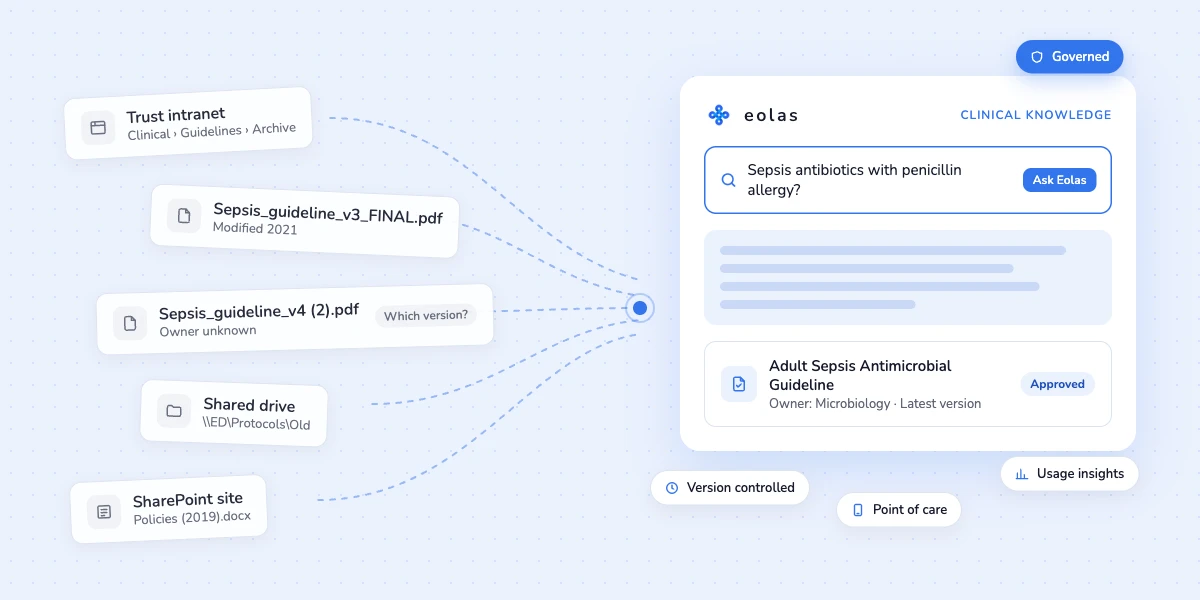
Clinical guidelines, policies, protocols and departmental resources are often spread across intranets, shared drives, document repositories and disconnected systems. Clinicians lose time searching for information that should be readily accessible. Knowledge owners struggle to keep content current. And leaders have limited visibility into how organisational knowledge is accessed and used.
Traditional systems are built to store and distribute documents. But healthcare organisations need more than storage: they need a way to organise, govern, access and understand their clinical knowledge.
Eolas is an enterprise clinical knowledge management platform for NHS trusts and healthcare organisations. It brings approved guidelines, policies, protocols and SOPs into one place, making clinical knowledge easier to manage and accessible to staff at the point of care through its guidelines app and AI-powered search.
This guide explores how Eolas compares with traditional approaches, including SharePoint, intranets, shared document repositories and standalone AI tools.
Why traditional approaches to clinical knowledge management fall short
Many healthcare organisations already have systems for storing and sharing information.
However, having somewhere to store documents does not necessarily mean clinical knowledge is being managed effectively.
Common challenges include:
- Fragmented knowledge: Clinical guidelines, policies, protocols and departmental resources are distributed across multiple locations.
- Inconsistent information: Multiple versions of documents make it difficult to identify the latest approved guidance.
- Limited ownership: Content review responsibilities and approval processes can be difficult to manage consistently.
- Poor accessibility: Clinical teams spend valuable time navigating different systems to find relevant information.
- Limited visibility: Healthcare leaders have little insight into what information staff are accessing or struggling to find.
Effective clinical knowledge management requires more than a central document repository. It requires a connected approach to organising, maintaining, accessing and understanding organisational knowledge.
Eolas vs alternative solutions: how do they compare?
Different tools offer different ways to store, manage and access clinical information. However, not all are designed to support the full lifecycle of clinical knowledge management.
| Capability | Eolas | SharePoint | Traditional intranets | Shared drives |
|---|---|---|---|---|
| Purpose-built clinical knowledge management | Yes | Configurable | Depends on platform | No |
| AI search across approved organisational documents | Yes, with Ask Eolas | Depends on configuration and licences | Depends on platform | No native capability |
| Content ownership and review management | Built in | Requires configuration and processes | Depends on platform | Usually manual |
| Version management | Yes | Yes | Depends on platform | Limited |
| Push updates with read-tracking | Yes | Requires configuration | Rarely | No |
| Department-managed content | Yes, with team Spaces | Usually a central team | Usually a central team | Folder-based |
| Search and usage analytics | Yes | Depends on configuration | Depends on platform | Limited |
| Mobile access | Web and mobile app | Web and mobile, depends on set-up | Depends on platform | Depends on implementation |
The key distinction is that Eolas brings knowledge management, access and organisational insight together in a platform designed for healthcare.
Other solutions may provide some of these capabilities, but often require additional configuration, processes or integrations.
1. Eolas vs SharePoint and NHS intranets
SharePoint and intranets are widely used by healthcare organisations to store documents, share information and support internal communication.
They offer useful capabilities, including document storage, collaboration, access controls, version history and integration with wider IT infrastructure.
However, managing clinical knowledge involves more than storing and publishing documents.
Healthcare organisations also need to consider how clinical information is governed, maintained, discovered and accessed across different departments and services. As intranets grow, navigation can become complicated and clinical teams may need to search across multiple locations to find relevant information.
Where Eolas offers a different approach
Eolas provides a dedicated environment for bringing clinical guidelines, policies, protocols and departmental resources together, making organisational knowledge easier to find and manage on desktop or mobile.
With Ask Eolas, users can search organisational knowledge using AI, helping them find relevant information without relying solely on document titles or folder structures.
The question isn't whether to replace your intranet. It's whether your current systems meet the specific needs of clinical knowledge management.
2. Eolas vs shared drives and document repositories
Shared drives and document repositories are familiar ways of storing clinical information. However, storage alone does not solve the wider knowledge management challenge.
For example, an organisation may have several versions of a clinical guideline stored across different folders. Staff may struggle to establish which version is current, who owns it or where to find it.
Eolas brings clinical knowledge into a managed environment. This helps organisations:
- Organise clinical knowledge across departments and services.
- Manage content ownership and review responsibilities.
- Maintain version history.
- Help staff find information quickly on desktop and mobile, at the point of care.
- Understand how knowledge is accessed and used.
3. Eolas vs standalone AI tools
AI tools are creating new opportunities to improve access to clinical information. However, the effectiveness of AI depends partly on the quality, relevance and governance of the knowledge it can access.
A standalone AI assistant may help users retrieve or generate information, but it does not automatically solve an organisation's underlying knowledge management challenges.
Organisations still need to establish:
- Which clinical information is approved for use.
- Who owns and maintains that information.
- How updates are reviewed and communicated.
- How AI tools access relevant organisational knowledge.
- How knowledge usage and gaps can be monitored.
Eolas provides this foundational requirement by providing a governed knowledge environment that can support clinician-facing experiences and other AI-enabled tools.
Through Ask Eolas and its integration capabilities, organisations can make their own institutional knowledge more accessible and support AI experiences grounded in approved organisational information.
In a peer-reviewed simulation study by Imperial College London researchers, published in npj Antimicrobials and Resistance, clinicians using Ask Eolas prescribed antibiotics with 100% accuracy, compared with 47% using standard PDF guidelines.
What to look for in clinical knowledge management software
When evaluating clinical knowledge management solutions, healthcare leaders should consider four areas.
Knowledge governance
Can the organisation establish clear ownership, manage review responsibilities and maintain audit-ready records of approved clinical information?
Accessibility
Can clinicians quickly find relevant information across departments and clinical settings?
Knowledge analytics
Can leaders understand what information is being accessed, what clinicians are searching for and where knowledge gaps exist?
AI readiness
Can the organisation make its approved institutional knowledge available to support AI tools and emerging clinical workflows?
These considerations help move the conversation beyond choosing another place to store documents.
The evidence behind Eolas
Eolas is used by more than 400,000 clinicians across 500+ sites in the UK, Ireland and the US.
- 9 times faster access to guidelines. Critical care staff at Sheffield Teaching Hospitals found guidelines almost 9 times faster with Eolas, saving 60 seconds per guideline. Read the case study
- No failed searches. In the same Sheffield study, staff could not find 11% of guidelines on the trust intranet, compared with 0% on Eolas.
- 8 minutes saved per search. Salford Royal's emergency department saves an average of 8 minutes per information search with bedside access through Eolas. Read the case study
“Eolas has made it quicker and easier to access guidelines.”
Why healthcare organisations choose Eolas
Eolas helps healthcare organisations move beyond fragmented information storage towards a more connected, governed and measurable approach to clinical knowledge management.
Improve quality of care
Make approved clinical knowledge easier to access, supporting consistency across clinical services.
Save clinical time
Reduce time spent searching across disconnected systems for policies, protocols and guidance.
Strengthen governance and compliance
Improve policy management, content ownership, version control and review processes, while maintaining clear audit trails.
Identify knowledge gaps and opportunities
Use search and engagement insights to understand what clinicians need and where additional knowledge or guidance may be required.
Build an AI-ready organisation
Create a governed knowledge foundation to support AI assistants, ambient scribes and other clinical tools.
Frequently asked questions
What is clinical knowledge management?
Clinical knowledge management is the process of capturing, organising, maintaining and sharing clinical information across a healthcare organisation. This includes guidelines, policies, protocols, SOPs, procedures and departmental knowledge, ensuring that relevant information is accessible, current and governed.
What is the difference between document management and knowledge management?
Document management focuses on storing, organising and controlling documents. Knowledge management goes further by making information discoverable, maintaining its relevance, understanding how it is used and helping organisations identify knowledge gaps.
Why do NHS organisations need clinical knowledge management?
Healthcare organisations need to ensure that clinicians can access relevant, approved and current information. Effective knowledge management can support clinical consistency, improve access to guidance and help organisations understand how institutional knowledge is being used.
Can Eolas support acute, community and primary care?
Eolas is designed to support healthcare organisations in managing and delivering institutional clinical knowledge across different healthcare settings. Its approach can support knowledge management requirements across acute, community and primary care environments.
Can Eolas support multiple departments and services?
Eolas supports the organisation of clinical knowledge across departments and services, helping different teams access relevant information within a shared knowledge environment.
Can Eolas integrate with existing healthcare systems?
Eolas supports integration capabilities designed to make governed organisational knowledge available across other tools and workflows. Specific integration requirements should be discussed with the Eolas team.
Does Eolas use AI?
Yes. Eolas includes AI-powered knowledge discovery and supports the use of governed organisational knowledge across AI-enabled workflows.
From fragmented information to connected clinical knowledge
Your organisation already has the clinical knowledge it needs. The challenge is ensuring that knowledge is organised, governed and accessible when it matters.
Eolas helps healthcare organisations bring their institutional knowledge together, improve access for clinical teams and build the foundations for more connected, knowledge-driven healthcare.
Related reading

Thought leadership
Evidence is a lagging indicator: what the largest AI scribe study actually tells us
The biggest real world study of ambient AI scribes found modest time savings and no measurable change downstream. Why we think the evidence is lagging the technology, not contradicting it.
Published

Thought leadership
From Heuristics to Transformers: The Shift in Knowledge Representation
How LLMs are reshaping medical knowledge - from rigid rules to real-time, adaptive decision support.
Published
Thought leadership
Pharma’s invisible content problem. Clinicians have moved on. The Industry hasn’t - and why GEO is the conversation we should all be having
How clinicians are accessing medical knowledge is changing from traditional search to AI based search, why is this important for industry?
Published