The State of Clinical Knowledge Management 2026
The Clinical Knowledge Gap
More evidence. More AI. Can clinicians reach the right answer when they need it?
Explore how clinical guidance is accessed across hours, devices and local workflows, and what these patterns mean for the knowledge beneath healthcare AI.
Free to read. No signup required.
Eolas Medical · October 2026 · 13 pages
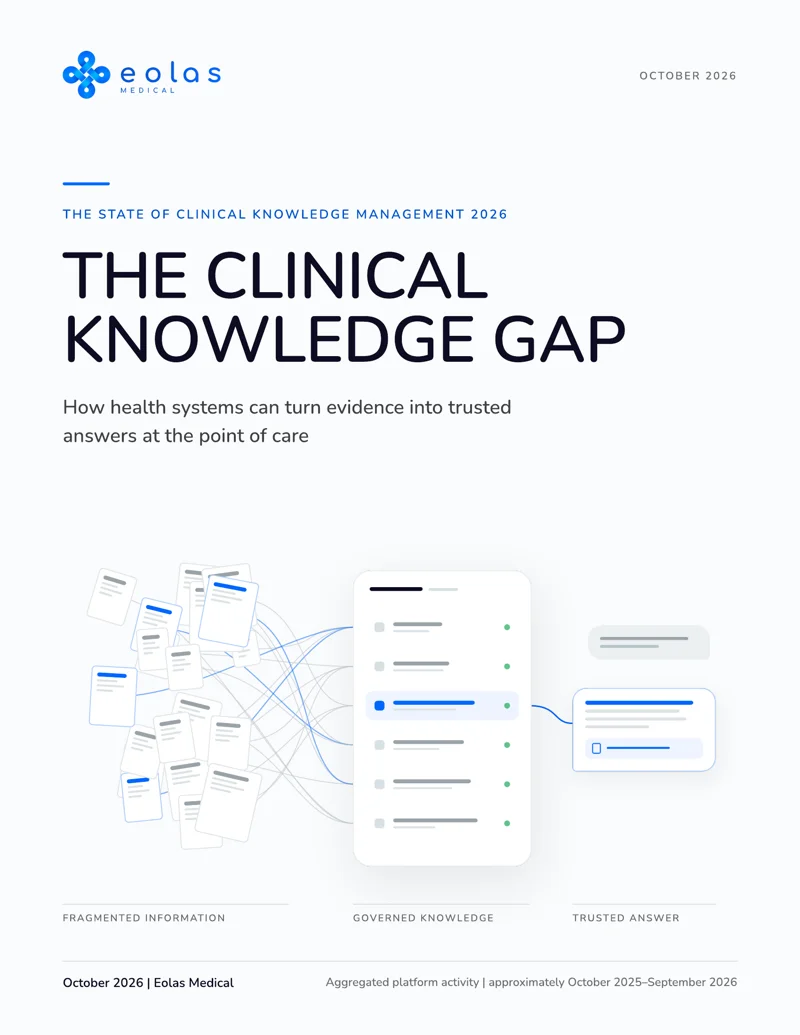
What happens between evidence and the answer?
Guidance has to work beyond office hours, across devices and within local workflows. As AI changes how clinicians ask questions, the knowledge behind the answer deserves closer attention.
Part 01
Beyond office hours
When guidance is accessed, and why availability has to match the clinical workflow.
Part 02
Evidence meets local context
Why the question is often, “What do we do here?”
Parts 05–06
The knowledge beneath AI
Making an answer’s sources visible, current and locally applicable.
Read online
The full report, 13 pages
Use the arrow keys or swipe to turn pages. Source links on the final page open in a new tab.
Loading the report…
Inside the report
What is the clinical knowledge gap?
Healthcare does not have an information shortage. Guidelines, journal articles, drug references, pathways and local protocols keep expanding, and AI is making access faster still. The gap the report describes is the practical distance between that evidence and a trusted, locally applicable answer that a clinician can reach at the point of care.
What the report explores
Guidance beyond office hours. Across UK protocol opens on Eolas, 38.7% occurred outside weekday 8am to 6pm or at weekends, and 16.3% between 10pm and 8am. That describes when guidance was opened, not staffing or unmet need.
Evidence meets local context. Within Eolas, local protocols were opened 5.5 times as often as national and global references. That does not mean national evidence matters less: local clinical guidance often carries it into practice, adding the formularies, pathways and escalation routes that apply in one organization.
Knowledge that travels with the clinician. 59.5% of protocol opens in the analyzed dataset happened on mobile devices. The report asks whether clinicians reach the same approved guidance on every device they use.
Sources behind AI answers. As natural-language questions sit alongside document navigation, some Ask Eolas answers were followed by a click to the underlying referenced document. Faster answers make the source more important, not less.
What these findings mean for healthcare leaders
This part is interpretation and recommendation. The report suggests treating clinical knowledge management as governed infrastructure rather than a library of documents. In practice that means clear ownership of each important protocol, one approved version, a reliable updating process, decisions about which sources AI can draw from, and access that fits clinical workflows on mobile and desktop. It closes with a ten-question readiness check, because knowledge governance for healthcare AI is not only a model question.
About the data and sources
- External research from public institutions, professional bodies, peer-reviewed studies and industry surveys describes the wider environment.
- Aggregate platform activity summarizes recorded access within Eolas from approximately October 2025 to September 2026, UK-led where indicated. It does not establish clinical outcomes, individual competence or the behavior of all clinicians, and event counts are not clinician counts.
- Interpretation is Eolas Medical’s view of what the combined signals may mean, set out as a framework rather than a measured outcome.
Sources cited in the report
- WHO Regional Office for EuropeArtificial intelligence is reshaping health systems: state of readiness across the WHO European Region (2025)
- OECDHealth at a Glance 2025: Data and digital
- American Medical AssociationPhysician sentiment report on augmented intelligence (March 2026)
- NHS EnglandNHS Staff Survey 2025: National Results Briefing
- Weller et al., BMJ Open (2026)Systematic review and meta-analysis of information source usage
- Del Fiol et al., JAMA Internal Medicine (2014)Clinical questions raised by clinicians at the point of care: a systematic review
- Wolters Kluwer Health, with IpsosFuture Ready Healthcare survey (March 2026)
Stay in touch
Curious about what comes next?
Get new perspectives on clinical knowledge and healthcare AI, our latest industry reports, and invitations to Eolas webinars, delivered to your inbox.