Thought leadership
Pharma’s invisible content problem. Clinicians have moved on. The Industry hasn’t - and why GEO is the conversation we should all be having
How clinicians are accessing medical knowledge is changing from traditional search to AI based search, why is this important for industry?
Published Updated
Every year, the pharmaceutical industry spends billions of dollars producing content. Peer-reviewed clinical summaries. Mechanism-of-action explainers. Treatment pathways, congress write-ups, real-world evidence reviews, educational content, brand websites. Material authored by deep therapy-area experts, governed through some of the most rigorous review processes in any industry.
And clinicians never see it.
Billions of misallocated resource every year. The number itself is debatable. The pattern isn't. Market research has consistently shown for some time now, that clinicians do not turn to pharmaceutical websites as a primary source of information, except in very specific scenarios.¹ Sites get built, content gets approved, MLR signs off, and the asset quietly disappears into the long tail of the internet. Some companies have started pulling websites altogether because the maintenance and compliance burden no longer justifies the traffic.
What makes this particularly uncomfortable is that HCPs aren't asking Pharma to be more sophisticated. They are asking for it to be less effortful. Recent research shows that around 69% of clinicians interact with digital channels every week, yet 65% have reduced or stopped engaging with a Pharma company because of poor digital experiences — and close to six in ten describe the content they do encounter as repetitive or irrelevant.² The message back from the customer is consistent and unambiguous: they don't need more websites, more portals, more branded apps and more logins to remember. They need faster access to relevant, trustworthy information, with less friction, inside the tools and workflows they are already using in their day to day.
The instinct inside the industry has too often been to respond to disengagement by building something more dynamic, more personalised, more AI-enabled. But layering intelligence onto an experience that already costs the clinician time and attention that doesn't focus on their challenges, doesn't fix the underlying problem — it compounds it. The opportunity is not to build another destination. It is to be present, accurately, at the point of care, in the moment a clinical question is actually being asked.
What makes this gap especially pointed is how invisible it is from inside the industry. Recent research found that around 82% of life sciences executives describe themselves as satisfied with their current customer engagement strategies — while only 28% of HCPs feel those strategies actually meet their needs.³ Pharma is, in effect, marking its own homework. And while the internal conversation continues to revolve around more content, more of the same ineffective channels, more email campaigns, more websites (please don’t make another website) the customer is quietly telling us it isn't a "more" problem at all. It is where and how clinicians choose to look for an answer in the first place.
It isn't a content quality problem. It's a distribution and discoverability problem and the ground is shifting under it.
How clinicians find information is changing — fast
The way anyone finds information is being redrawn by large language models (ChatGPT alone has 900 million weekly active users). Hundreds of millions of people now ask Large Language Models (LLMs) ChatGPT, Gemini, Claude etc a question and expect an answer, rather than a list of ten blue links. Around 60% of public searches now end without a click.⁴ Healthcare is, by some distance, the most affected category: AI summaries appear above the fold in over half of healthcare-related searches in recent samples.
Clinicians are no different. Surveys of verified healthcare professionals consistently show that more than half are already using AI-powered search in their professional roles, with most of the remainder planning to.⁵
But a challenge still remains, and that is trust. A recent scoping review comparing public search engines (Dr Google) with general-purpose AI tools (Dr ChatGPT) found hallucinated or fabricated references in 31-45% of clinical answers, with source transparency frequently limited or absent altogether.⁶ AI can sound highly convincing while being quietly wrong, and in a clinical context that is not a problem the industry can afford to be relaxed about.
What clinicians need, and what the next generation of trusted AI search has to deliver, is a clear, auditable line of sight back to the underlying content: which guideline, which paper, which protocol was actually used to generate the answer, and whether it is the right one for the clinical question in front of them.
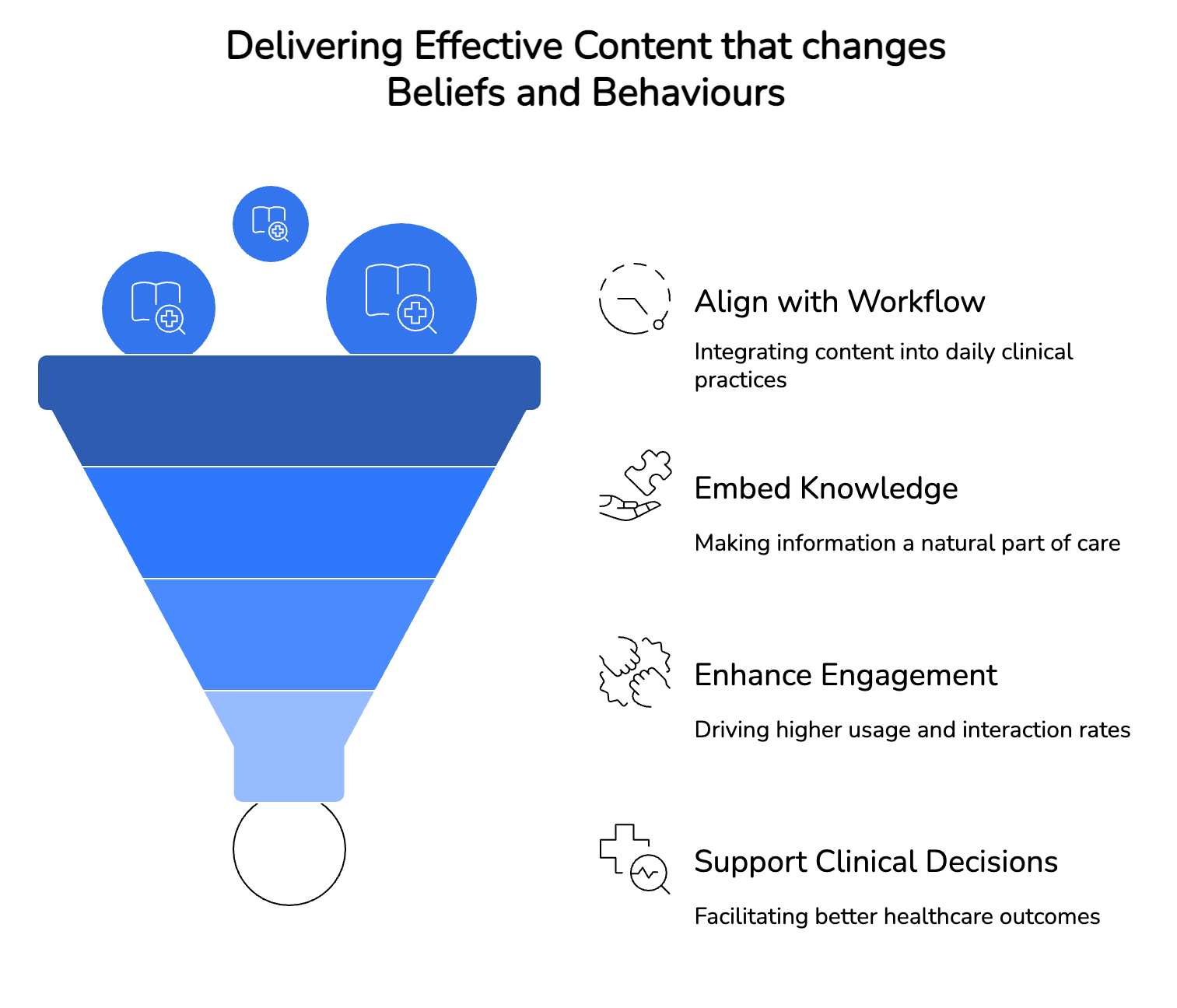
This touches on another trend. The clinician shift away from standalone information portals and towards tools embedded in the clinical workflow at the point of care. It is happening on the ward, in the clinic, and in the consultation room. The same logic that drove the rise of ambient voice technology tools is now playing out across other pain points in the workflow.
Enter Generative Engine Optimisation
Generative Engine Optimisation (GEO) is the discipline of structuring, sourcing and presenting content so that AI systems surface it accurately and reliably when a user asks a question. If SEO determines which web pages a person saw, GEO determines which content an AI model trusts enough to cite.
The intellectual foundation is already well established. Google's EEAT framework — Experience, Expertise, Authoritativeness, Trustworthiness — originally written for human quality raters, has become the standard for generative AI as well.⁷ For what Google classifies as "Your Money or Your Life" topics, of which healthcare is the canonical example, the bar is materially higher. AI models are trained to weight credible sources. Content that lacks demonstrable expertise, clear authorship and rigorous sourcing simply doesn't make it into the answer. Or that’s how it should work. The challenge with LLMs is the volume of content on the internet feeding into these models, that are unvalidated or unrefined for healthcare as an appropriate use case.
Why Pharma can't just optimise for ChatGPT and other LLMs
Here the conversation diverges sharply from consumer marketing. A retail brand can chase visibility inside ChatGPT + other LLMs, accept some accuracy risk, and call it a result. Pharma cannot. The audience inside those consumer tools is overwhelmingly the general public, not verified HCPs (for now) — so the targeting is wrong before the content even loads. There are limitations to see who is asking what, which content is being surfaced, or whether the answer faithfully reflects the source it came from. And given documented cases of AI summaries materially misrepresenting clinical information, the reputational exposure is real, not hypothetical.
What Pharma needs is GEO inside trusted, governed environments. Places where the audience is verified, the underlying content base is curated, every output is auditable, and the answer cites its source clearly. It comes down to one thing. Trust.
The forward thinkers are already moving
This isn't a future problem being theorised in strategy decks. Leading organisations, from global and local, commercial and medical, are already allocating headcount and budget to AI search readiness. A growing share of agencies have stood up dedicated GEO offerings in the last twelve months. A vendor ecosystem is forming around MLR-compliant content preparation, automated structuring, schema and entity tagging. The conversation is real, and it is accelerating.
The harder truth is that most of this activity is being shaped by the wrong instincts. A great deal of what is being labelled GEO today is run through the same old lens by people whose expertise was built for a different era of discovery and without a sharper understanding of what is actually changing, the industry is on course to misallocate another wave of resource into work that won't move the needle.
The unlock: verified distribution plus governed insight
The piece that is most often missed is this: GEO is not only about how content is prepared. It is about where and how it is distributed.
Deploying GEO-ready content through a trusted AI search tool with a verified, consented HCP audience does two things at once. It solves compliance barriers, because the audience, the sources and the outputs are all governed and auditable. And it unlocks something Pharma has never reliably had: granular insight into what clinicians are actually asking at the point of care, which content is being surfaced, how often, by whom, and to what effect. A genuine signal of unmet clinical need, fed back to a stakeholder who is placed to fill it.
This is the next frontier, and it is the reason GEO matters more to our industry than to any other. The credibility infrastructure that Pharma already invests in, clinician-authored content, peer-reviewed evidence, validated platforms, published research, is exactly the infrastructure AI systems are built to reward. The work, in many cases, is already done. It’s the channels that have been missing.
The defining question
We are at the start of the most significant shift in how clinicians discover information since the arrival of Google. A great deal of the content produced over the last decade was not wasted, it has been waiting for a distribution model that didn't yet exist. That model is now emerging, and the organisations that build for it deliberately, responsibly and early will set the standard for what credible AI-mediated engagement with healthcare professionals actually looks like.
Which leaves one question worth sitting with: is your strategy built for how Pharma still believes clinicians find information — or for how they actually do?
References
- EPG Health - multi stakeholder study The gaps between HCP demand and pharma supply of medical information - October 2021
- Graphite Digital- The Value Gap: `What HCPs want from pharma digital in 2026 https:// www.Graphitedigital. com/downloads/the-value-gap
- Deloitte Report: Unlocking the Future of Customer Engagement in Pharma. 20 March 2025
- Bain & Company article: Goodbye Clicks, Hello AI: Zero-Click Search Redefines Marketing. Feb 2025 www.bain. com/insights/goodbye-clicks-hello-ai-zero-click-search-redefines-marketing/
- Varn Health Report: The rise of AI-search usage amongst HCPs, and what that means for health communications. Feb 2026 varnhealth. com/industry-insights/hcp-ai-search-usage/
- Trillo-Domínguez, M.; Martin-Neira, J.I.; Olvera-Lobo, M.D. Dr. Google vs. Dr. ChatGPT in Online Health Self-Consultation: A Scoping Review of Accuracy, Bias, and Actionability (2023–2025). Informatics 2026, 13, 41. https//doi .org/10.3390/informatics13030041
- Google Guidelines Search Rating Quality
Related reading

Thought leadership
Evidence is a lagging indicator: what the largest AI scribe study actually tells us
The biggest real world study of ambient AI scribes found modest time savings and no measurable change downstream. Why we think the evidence is lagging the technology, not contradicting it.
Published

Thought leadership
From Heuristics to Transformers: The Shift in Knowledge Representation
How LLMs are reshaping medical knowledge - from rigid rules to real-time, adaptive decision support.
Published
Thought leadership
Delivering Clinical Knowledge at the Point of Care: Engaging HCPs with Timely, High-Quality Content
Timely, embedded content boosts HCP engagement and patient care.
Published