
Thames Valley Air Ambulance is a Helicopter Emergency Medical Service (HEMS) providing pre-hospital critical care. The Clinical Operations team needed reliable, fast access to guidelines, checklists, and clinical documents in challenging environments — often reliant on mobile data in locations with limited connectivity.
The previous system, Radar, had an app with such poor user experience that it went completely unused. It was slow, unreliable, and often failed to sync. The website interface was clunky, had aggressive logout timers, and made it difficult to locate documents quickly. For a service dealing with time-critical pre-hospital emergencies, this friction had serious consequences — rapid action cards for specific conditions were rendered useless by the time it took to log in, navigate CAPTCHAs, and wait for documents to load.
Workarounds involving locally saved documents on OneDrive and printed guidelines created major governance risks, as there was no reliable way to ensure documents were up to date across multiple devices and locations.
The transition to Eolas Medical required no formal training. Staff were simply told to download the app and request access to the space. No clinicians took issue with the change, and all preferred it to the existing method. When the old systems were run concurrently for several months, no one used them — everyone chose Eolas Medical.
The platform has dramatically reduced the friction associated with accessing clinical information. Teams can consistently access guidelines and checklists quickly, with as few taps as possible. The reliability of updates means that when an administrator changes content, it is immediately available to all users — eliminating the governance risk of outdated local copies.
An internal survey found that 97% of respondents used their own personal devices in preference to the duty iPhones and iPads supplied by the service. Eolas Medical's BYOD compatibility means clinicians can access everything they need on the device they are most comfortable with.
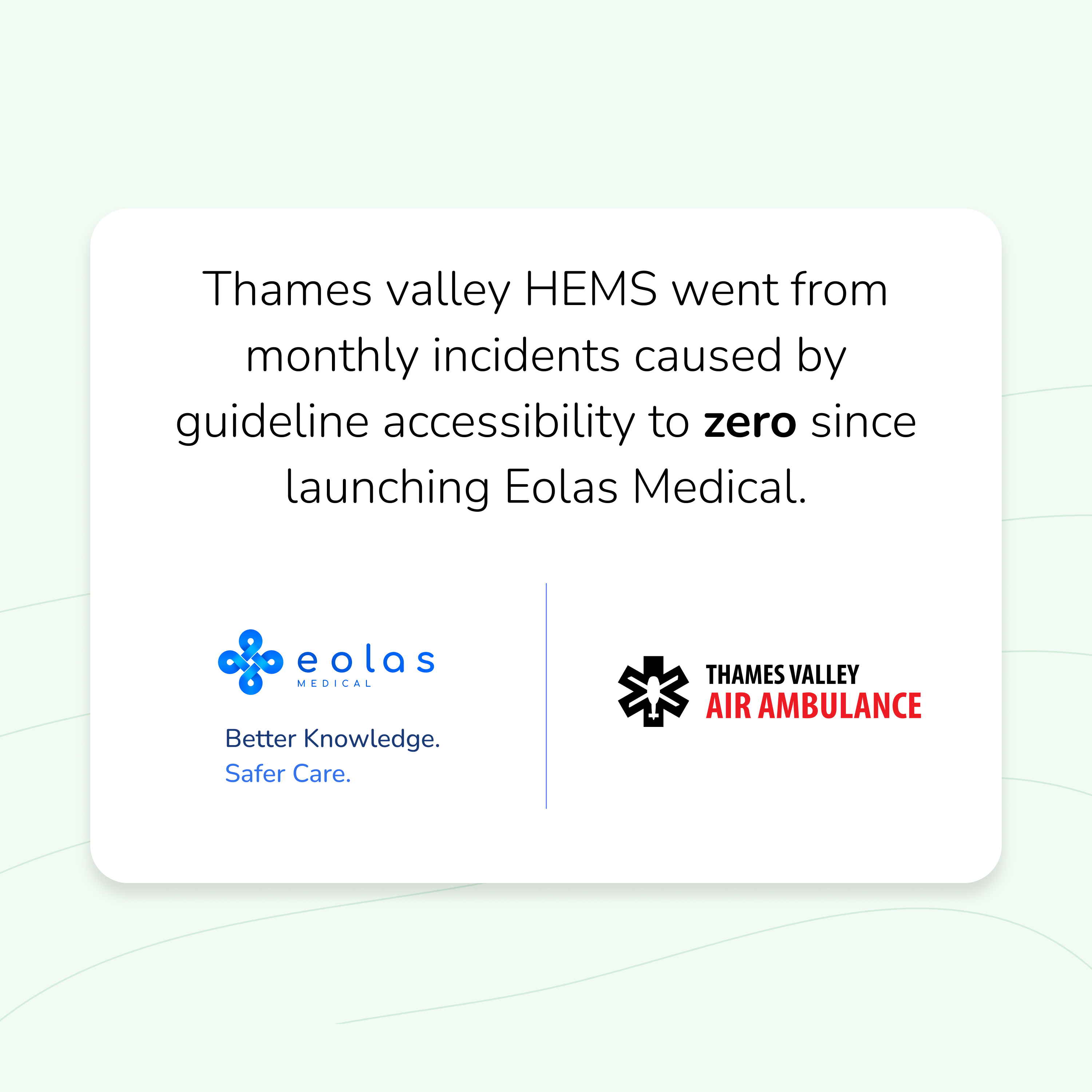
The most striking outcome has been the elimination of guideline accessibility incidents. Before Eolas Medical, the service experienced approximately monthly incident reports where guidelines were inaccessible or caused a delay. In over a year since Eolas Medical was introduced, there have been zero such incidents — a transformative improvement for patient safety in pre-hospital critical care.
Staff have reported significantly reduced frustration and better ability to use their own devices. Teams have actively requested that additional documentation be moved into Eolas Medical, demonstrating strong confidence in the platform. The ease of organising and uploading new documents has also been a major advantage for administrators.
The service has identified Toxbase integration and AI-powered guideline search as areas of future interest, envisioning the ability to query specific clinical parameters directly from within guidelines for even faster decision support at the point of care.

%201.svg)
%201.svg)


